Castello della Colombaia
Medieval sea fortress guarding Trapani's harbour.
The Castello della Colombaia is a historic sea fortress in Trapani, developed during the Middle Ages on an islet guarding the entrance to the city's harbour.
Key facts
Site type:
Comune:
Castle
Trapani
District:
Harbour
Standing on a small islet at the entrance to Trapani's harbour, the Castello della Colombaia — also known as the Castello di Mare and Torre Peliade — formed a key element of the city's maritime defences. Ancient sources describe an island called Peliades off Drepanum associated with a Carthaginian tower, although the relationship between this account and the surviving fortress remains uncertain.
The castle visible today developed through successive medieval and early modern building phases. Its dominant feature is a 32-metre octagonal tower, probably constructed in the late 13th century, which was subsequently incorporated into a larger elliptical fortified enclosure. The complex was repeatedly strengthened as military technology changed, including major 16th- and 17th-century works designed for artillery defence.
The Colombaia continued to serve military purposes for centuries and was also used to hold prisoners from at least the 16th century. It was increasingly employed as a prison under the Bourbons and became a formal penal institution after Italian unification, remaining in use until 1965 apart from a wartime interruption. After its closure the complex suffered prolonged deterioration, leading to successive campaigns of consolidation and restoration intended to secure the surviving structures and enable their future reuse.
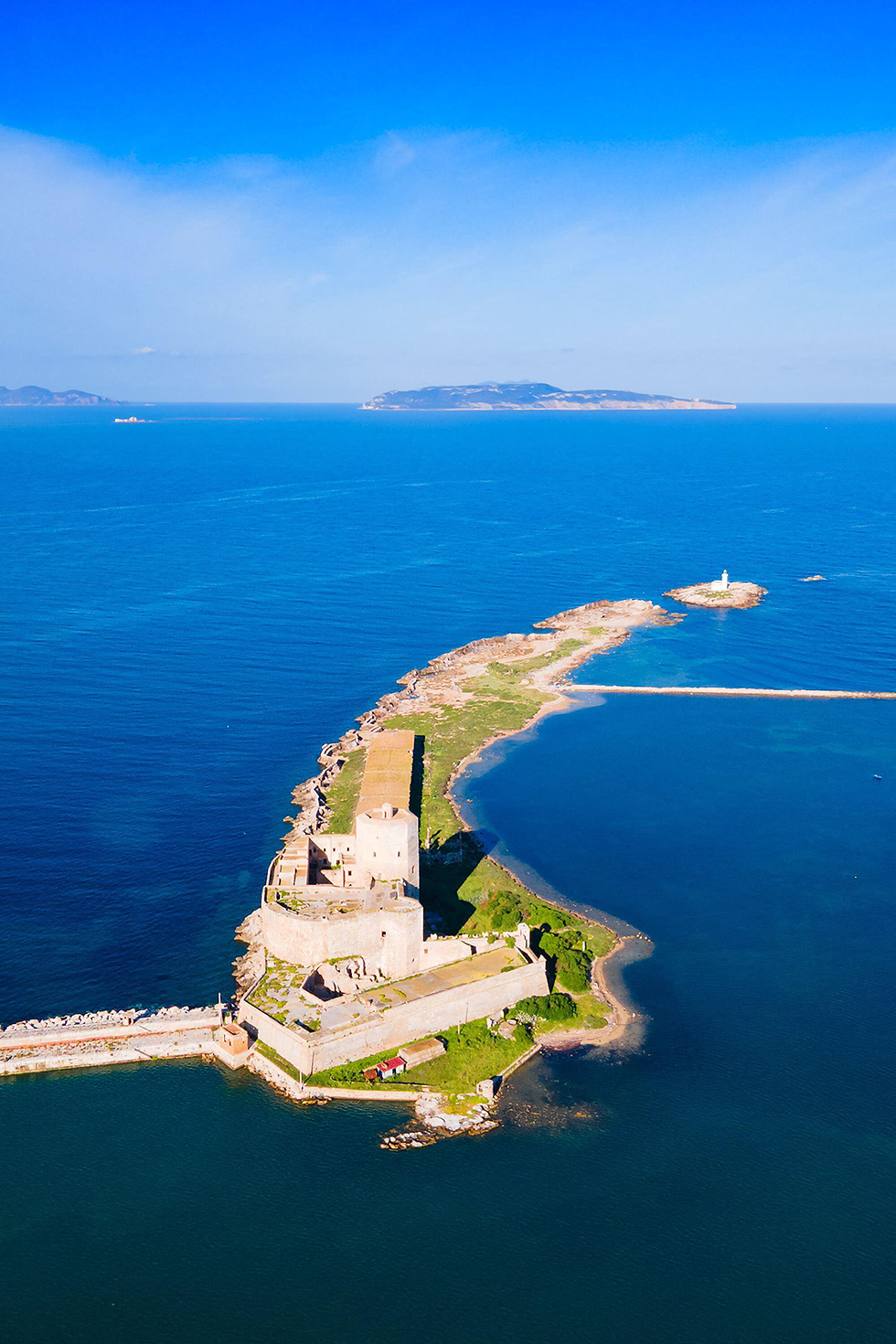
Photo: Andrey Khrobostov
Explore further
Explore the ancient traditions, architectural development and changing military functions of the Colombaia, from the possible Peliades of classical sources to the successive fortifications that shaped the surviving castle.
Peliades and the ancient harbour
The possible ancient origins of the Colombaia are connected with the strategic importance of Drepanum during the conflicts between Carthage and Rome. Ancient accounts cited in modern studies refer to an island called Peliades in front of the city and associate it with a tower constructed by the Carthaginians during the First Punic War.
According to the account transmitted through Zonaras from Cassius Dio, the Roman consul Numerius Fabius Buteo captured the position in 260 BCE. Other traditions describe the Romans filling the narrow channel separating the island from the mainland with stones and earth so that siege machinery could be brought across; after recovering the position, the Carthaginians are said to have restored its insular character.
The identification of Peliades with the later Colombaia has a long history, but it does not establish that any part of the surviving castle is Punic. Giovanni Vultaggio notes that the medieval name Columbara may preserve the meaning of the ancient name Peliades, derived from the Greek peleia, meaning a wild dove or pigeon. The surviving architectural evidence, however, belongs principally to medieval and later phases.
The medieval towers
Architectural analysis suggests that the medieval Colombaia developed around more than one tower. An earlier eastern tower, whose original form may have been hexagonal, has been tentatively interpreted by Vultaggio as Arab or Norman in date.
The great octagonal turri mastra, which still dominates the complex, represents a later phase. Approximately 32 metres high, it has traditionally been assigned to the early 14th century, but Vultaggio's stratigraphic analysis proposes an earlier date towards the end of the 13th century, possibly in connection with the strengthening of Trapani's defences begun under James of Aragon in 1286.
The two medieval towers were subsequently incorporated within a fortified enclosure. During the 14th century this developed into the large elliptical complex that still determines the basic form of the castle.
From medieval castle to artillery fortress
The introduction of increasingly powerful firearms required substantial changes to the Colombaia. During the first half of the 16th century, the seaward side of the medieval enclosure was extensively refaced and strengthened to improve its resistance to artillery.
Around 1550, under Viceroy Juan de Vega, the eastern part of the medieval enclosure was filled and raised to create a massive artillery platform or propugnacolo. Vultaggio describes this structure as approximately 17 metres high, 30 metres long and 20 metres deep.
A further major transformation followed in 1673. On the orders of Viceroy Claude Lamoral, Prince de Ligne, the military engineer Carlos de Grunenbergh constructed a new polygonal bastioned work on the eastern side. Vultaggio notes that this fortification faced towards Trapani rather than out to sea, interpreting its orientation in the context of contemporary civic unrest and the defence of royal authority.
The Colombaia therefore preserves the results of several distinct construction campaigns rather than a single medieval design: earlier towers, the medieval elliptical enclosure and successive artillery fortifications were incorporated into the complex over several centuries.

A military harbour?
Research into the waters surrounding the Colombaia has raised further questions about the historical organisation of Trapani's harbour. Vultaggio has documented submerged and semi-submerged walls, embankments, channels and artificial cuts in the rocky islets between the Colombaia, the Lazzaretto and Villino Nasi.
Some of these remains had previously been interpreted as structures connected with salt production or fishponds. Vultaggio instead proposes that they may form part of a more extensive system associated with the control and defence of the harbour, creating protected areas for vessels with several possible entrances and exits.
Their date and function have not been established archaeologically. Vultaggio presents possibilities ranging from the Punic period to Byzantine activity or the conflicts of the War of the Sicilian Vespers, while emphasising that underwater archaeological investigation would be necessary to test these hypotheses.
From fortress to prison
The Colombaia was used to hold prisoners by at least the 16th century, while its use for detention increased during the Bourbon period. It became formally established as a prison after Italian unification, when Trapani lost its status as a fortified military place.
The prison remained in operation until 1965, with an interruption during the Second World War. Between 1939 and 1943, new structures were constructed on the island in connection with the manufacture of mines, including large sheds and a reinforced-concrete tunnel inserted into the base of the 16th-century propugnacolo.
The castle returned to prison use after the war before finally closing in 1965. Its subsequent abandonment, combined with its exposed maritime setting, contributed to the deterioration of the historic structures.
Conservation and restoration
Attempts to secure and conserve the Colombaia have taken place over several decades. Restoration work directed by architect F. Terranova in 1993 included consolidation of the octagonal tower and removal of later additions from its interior. Structures associated with a former lighthouse and communications equipment at the top of the tower were also partly removed because their weight was affecting its stability.
The complex underwent further safety works in 2012. A new programme of restoration was subsequently developed with public funding, with works beginning in 2024 as part of efforts to consolidate the monument and prepare it for future use.
The eventual function of the restored complex has been the subject of different proposals over time. These proposals should be distinguished from the conservation programme itself, which is concerned with securing and restoring the historic fabric of the Colombaia.
Sources & further reading
Explore the official documentation and research used to trace the development of the Castello della Colombaia from its traditional ancient origins through its medieval fortification, prison use and modern conservation.