Church of San Carlo
17th-century church and former institution associated with Erice’s convent pastry tradition
San Carlo is a 17th-century church and former charitable institution founded for orphaned girls, later known for its enclosed community, traditional confectionery and association with the pastry-maker Maria Grammatico.
Key facts
Site type:
Comune:
Church
Erice
District:
Historic centre
The Church and former Institute of San Carlo were founded in 1617 by the priest Pietro Maranzano as a charitable institution for orphaned girls. Although its residents lived an enclosed religious life as Franciscan tertiaries, San Carlo remained a lay institution rather than a conventional monastery, allowing it to survive the suppression of religious corporations in 1866.
Supported by donations and bequests, the institution gradually expanded by acquiring neighbouring buildings until the complex occupied much of the surrounding block. The adjoining church, dedicated to Saint Charles Borromeo, was completely rebuilt in 1844. Its single-nave interior has five altars and retains an 18th-century maiolica pavement.
The women of San Carlo became particularly known for embroidery and confectionery. Among those who learned the institution's pastry-making traditions was Maria Grammatico, who lived at San Carlo as a child and later established one of Erice's best-known pastry businesses.
The institution declined during the 20th century and eventually closed. The former monastery subsequently housed the La Salerniana contemporary art collection before being restored and converted into boarding accommodation for students of the Istituto di Istruzione Superiore “Ignazio e Vincenzo Florio”. The church itself was restored and reopened in 2003.
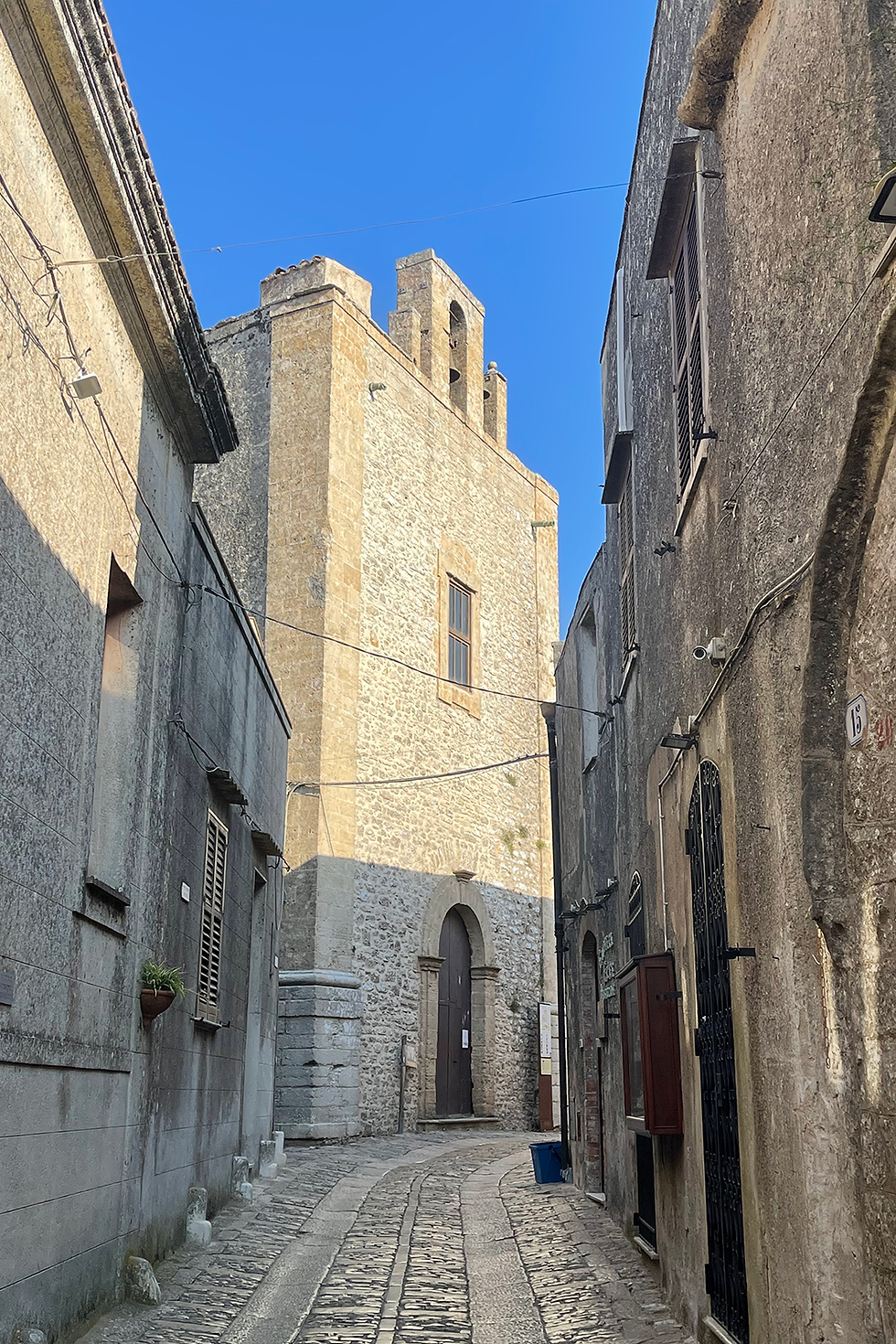
Photo: Elymian Atlas
Explore further
Discover the history, architecture, archaeology, people and events connected with this place, with more detailed information about its origins, development and significance.
Foundation of San Carlo
The Institute of San Carlo was founded in 1617 by the priest Pietro Maranzano, who provided premises and an endowment for an institution intended to accommodate and protect orphaned girls.
The foundation attracted support from Erice's wealthier families. Donations and testamentary bequests increased its resources, allowing the institution to acquire neighbouring properties and gradually enlarge its premises.
Rather than developing as a single purpose-built monastery, San Carlo therefore expanded through the incorporation of existing houses and other structures. The resulting complex eventually occupied a substantial part of the surrounding block, and traces of the earlier buildings remained visible within its fabric.
The women of San Carlo
Despite commonly being described as a monastery, San Carlo had an unusual institutional status. It was a lay charitable foundation and did not belong to a monastic order.
The women living there were Franciscan tertiaries. They observed an enclosed way of life, but according to Tusa this was maintained through established custom rather than the formal obligations of a cloistered religious order.
This distinction became particularly important following the unification of Italy. Because San Carlo was a lay charitable institution, it was excluded from the confiscations associated with the suppression of religious corporations in 1866 and continued to operate.
The women taught activities including embroidery and confectionery, skills that became closely associated with life at San Carlo.
The church and its interior
The church dedicated to Saint Charles Borromeo was originally constructed at the time of the foundation of the institute in the early 17th century. The present building, however, largely results from a complete rebuilding undertaken in 1844.
Its exterior forms part of the austere stone architecture of the larger San Carlo complex. The church has a single spacious nave with restrained Baroque decoration and five altars, including the high altar.
The interior retains an 18th-century maiolica pavement produced by Neapolitan craftsmen. Its artworks include paintings and devotional images associated with the religious life of the institution.
The church was closed for many years during the later 20th century. Following restoration, it reopened in 2003.
The sweets of San Carlo
Confectionery formed an important part of life at San Carlo and eventually also contributed to the institution's income.
The women became known for producing traditional Ericine sweets, continuing a wider Sicilian tradition in which convents and female religious communities developed elaborate pastries using ingredients such as almonds, preserved fruit and sugar.
During the difficult years following the Second World War, the declining value of the institution's revenues left the community increasingly dependent upon outside financial support. The production and sale of traditional sweets provided an additional source of income.
Among the specialities associated with San Carlo was pasta reale, the sweet almond paste characteristic of Sicilian confectionery.
Maria Grammatico
The confectionery tradition of San Carlo acquired a wider legacy through Maria Grammatico, who entered the institution as a child in 1952.
During the years she spent there, Grammatico learned the techniques used by the women to prepare the institution's traditional pastries and almond sweets. She left San Carlo in 1964 and subsequently established her own pastry business in Erice.
Her work brought recipes and techniques learned within the enclosed institution into the commercial pastry tradition of modern Erice. The connection between San Carlo and Grammatico therefore provides a direct link between the town's former religious communities and a culinary tradition that continues today.
Decline and closure
San Carlo experienced increasing financial difficulties during the decades following the Second World War. Income from its traditional endowments declined in value, while the number of women living in the institution gradually diminished.
The institute eventually ceased operating in 1970, and the last nun left the complex in 1978.
By then the buildings required substantial intervention, while the church had also suffered damage and remained closed to worship for many years.
La Salerniana
Following the closure of the institution, parts of the former monastery remained largely unused before the complex acquired a new cultural function.
It became associated with La Salerniana, an organisation devoted to modern and contemporary art. Its collection and exhibitions brought works by Italian and international artists into the former monastic spaces, giving San Carlo a new role within the cultural life of Erice.
The collection was housed at San Carlo for many years before later being transferred elsewhere in the town.
San Carlo today
A major restoration subsequently gave the former institute another new use.
In 2021 the restored monastery was formally handed over for use by the Istituto di Istruzione Superiore “Ignazio e Vincenzo Florio”. The building now serves as the school's convitto, providing residential accommodation for students in the historic centre of Erice.
The adaptation continues the long residential and educational history of the complex while giving the former institution a contemporary function.
The adjoining church remains a separate historic religious space. Following restoration, it reopened in 2003.
Sources & further reading
Explore the historical sources, archaeological research, books, academic studies and official records used to document this place, with links for further reading and research.