Church of San Francesco
Medieval Franciscan church with a 14th-century convent
The Church of San Francesco is a 14th-century Franciscan church in Erice, founded by Francesco II Ventimiglia and historically also known as the Church of the Holy Spirit.
Key facts
Site type:
Comune:
Church
Erice
District:
Historic centre
The Church of San Francesco and its adjoining convent were founded in the 14th century following a papal bull issued by Pope Urban V at Avignon on 22 August 1362 and formally presented in Catania in 1364. The foundation was established by Francesco II Ventimiglia, Count of Geraci, on the site of the Palazzo Abbati, traditionally associated with the birthplace of Saint Albert of Trapani. The first Mass was celebrated in the church in 1370.
The original Franciscan complex was substantially developed in later centuries. In 1598 the guardian Tommaso Angelo enlarged the convent and added a cloister, while subsequent works included a grand staircase in the late 17th century, new dormitories, an 18th-century carved walnut choir and extensive stucco decoration by Giacomo Giacomazzo of Trapani.
Following the suppression of the religious community in 1866, the former convent acquired new civic uses and later became the San Raffaele Arcangelo municipal hospital. Since the 1970s the complex has been associated with the Ettore Majorana Foundation and Centre for Scientific Culture and today houses its Eugene P. Wigner Institute. The church itself remains a place of worship.
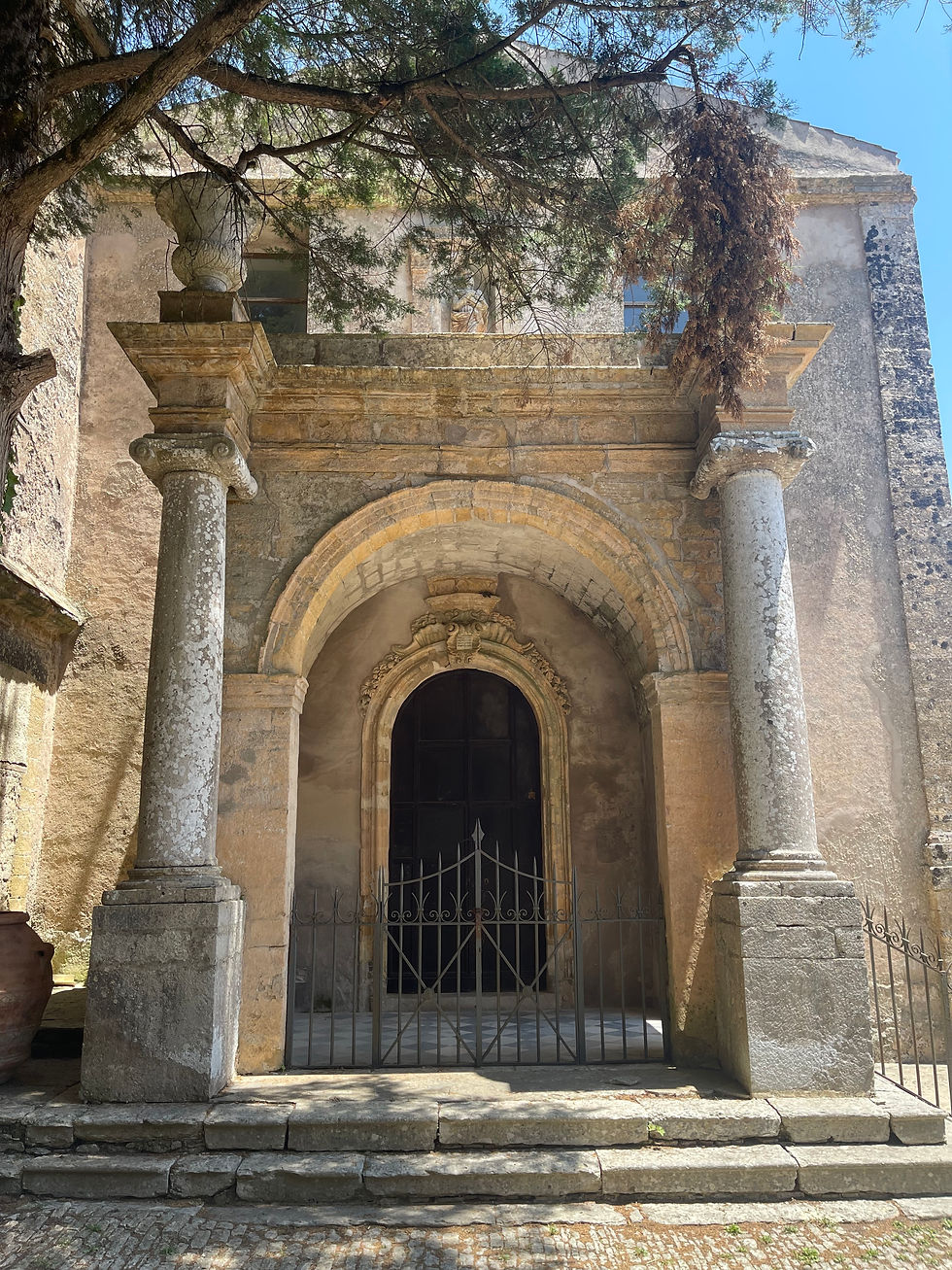
Photo: Elymian Atlas
Explore further
The Palazzo Abbati and Saint Albert
Before the establishment of the Franciscan convent, the site was occupied by the Palazzo Abbati, associated with the degli Abati—or Abbati—family of Erice.
Local historical tradition identifies this palace as the birthplace of Saint Albert of Trapani, born Alberto degli Abati in the 13th century and later one of the most important early saints of the Carmelite Order. The 19th-century historian Giuseppe Castronovo records the tradition while drawing upon earlier Ericine chroniclers including Antonio Cordici and Spalla. The identification should therefore be understood as a longstanding local tradition rather than a securely documented birthplace.
The foundation of San Francesco consequently linked a new Franciscan religious complex with a site already associated in Ericine memory with one of the town's most important religious figures.
Francesco II Ventimiglia and the Franciscan foundation
The patron responsible for the new foundation was Francesco II Ventimiglia, known as Franceschello, one of the most powerful Sicilian nobles of the later 14th century.
A member of the Ventimiglia family and Count of Geraci, Francesco controlled extensive territories in the Madonie and northern Sicily. His career placed him at the centre of the island's turbulent late-medieval politics. Following the death of Frederick IV in 1377, he became one of the Four Vicars, the group of powerful barons who governed Sicily in the name of the young Queen Maria.
His patronage at Erice began earlier. Following the bull issued by Pope Urban V on 22 August 1362, Francesco established the church and Franciscan convent on the site of the Palazzo Abbati. The papal document was formally presented in Catania in 1364, and the first Mass at the new church was celebrated in 1370.
The foundation therefore belongs not only to the religious history of Erice but also to the wider pattern of aristocratic patronage that shaped medieval Sicily.
The development of the convent
The Franciscan complex remained comparatively modest during its first centuries. A significant period of expansion began in 1598, when the guardian Tommaso Angelo enlarged the convent and constructed a cloister, creating the nucleus of the complex that survives today.
Further alterations followed. A grand staircase was constructed towards the end of the 17th century, while the 18th century brought new dormitories and a carved walnut choir. The interiors were also enriched with extensive stucco decoration by Giacomo Giacomazzo of Trapani.
These successive interventions transformed the medieval foundation into a considerably larger religious institution, with the church, cloister and convent buildings serving both the Franciscan community and the wider town.
Beyond the religious community
The convent was not entirely isolated from civic life. Historical accounts record that its buildings were used to accommodate important visitors and, on occasion, troops.
A much more fundamental change followed the suppression of religious corporations in 1866. The convent ceased to function as a Franciscan house and subsequently acquired a new public role as the San Raffaele Arcangelo civic hospital, adapting the former monastic buildings to the needs of the local community.
The survival of the complex therefore reflects several distinct phases of Erice's history: medieval aristocratic and religious patronage, Franciscan monastic life and the conversion of former ecclesiastical property to civic use after Italian unification.
From convent to scientific institute
Another transformation began in the 20th century. Since the 1970s the former convent has been used by the Ettore Majorana Foundation and Centre for Scientific Culture, which established the Eugene P. Wigner Institute within the historic complex.
The former convent consequently continues to serve an institutional and educational purpose, accommodating scientific teaching and international academic activity within buildings created for a medieval religious community.
The cloister and other surviving convent spaces preserve the historic character of the complex, while the adjoining Church of San Francesco remains in religious use.
San Francesco or Spirito Santo?
The church appears in historical and modern sources under both San Francesco and Spirito Santo (Holy Spirit). The name San Francesco reflects its origins as part of the Franciscan convent and its association with Saint Francis of Assisi, while Chiesa dello Spirito Santo is also recorded as a name for the church.
Today San Francesco is the more familiar name for the complex and is also preserved in the name of Via San Francesco, on which the church stands.
Sources & further reading
Explore the historical sources, academic research and official records used to document the Church of San Francesco, its Franciscan convent, the site's association with Saint Albert of Trapani and the patronage of Francesco II Ventimiglia.