Church of San Giuliano
Ancient church at the heart of Erice's medieval identity.
The Church of San Giuliano is one of Erice's oldest churches, traditionally linked to the Norman conquest and to the saint who gave the medieval town its name.
Key facts
Site type:
Comune:
Church
Erice
District:
Historic centre
The Church of San Giuliano stands on the eastern side of Erice's historic centre and is one of the town's four historic parish churches. Its origins are traditionally associated with the Norman conquest of western Sicily: according to later accounts, Roger I of Sicily founded a church here in the 11th century, although some traditions place Christian worship on the site even earlier. The church is securely documented during the medieval period and was already a parish by 1423.
The medieval building was substantially transformed between 1612 and 1615, when it was rebuilt on a larger scale with three naves. Its distinctive bell tower, now one of the most recognisable features of Erice's skyline, was added in 1770.
Part of the church collapsed in 1926, forcing its closure. After almost eighty years it reopened on 26 December 2005 following restoration.
Today San Giuliano also preserves the Misteri, sculptural groups depicting the final hours of Christ's life. Adjoining rooms contain displays devoted to ceroplastica, the art of wax modelling once practised in Erice's religious communities, including by the Carmelite nuns of Santa Teresa.
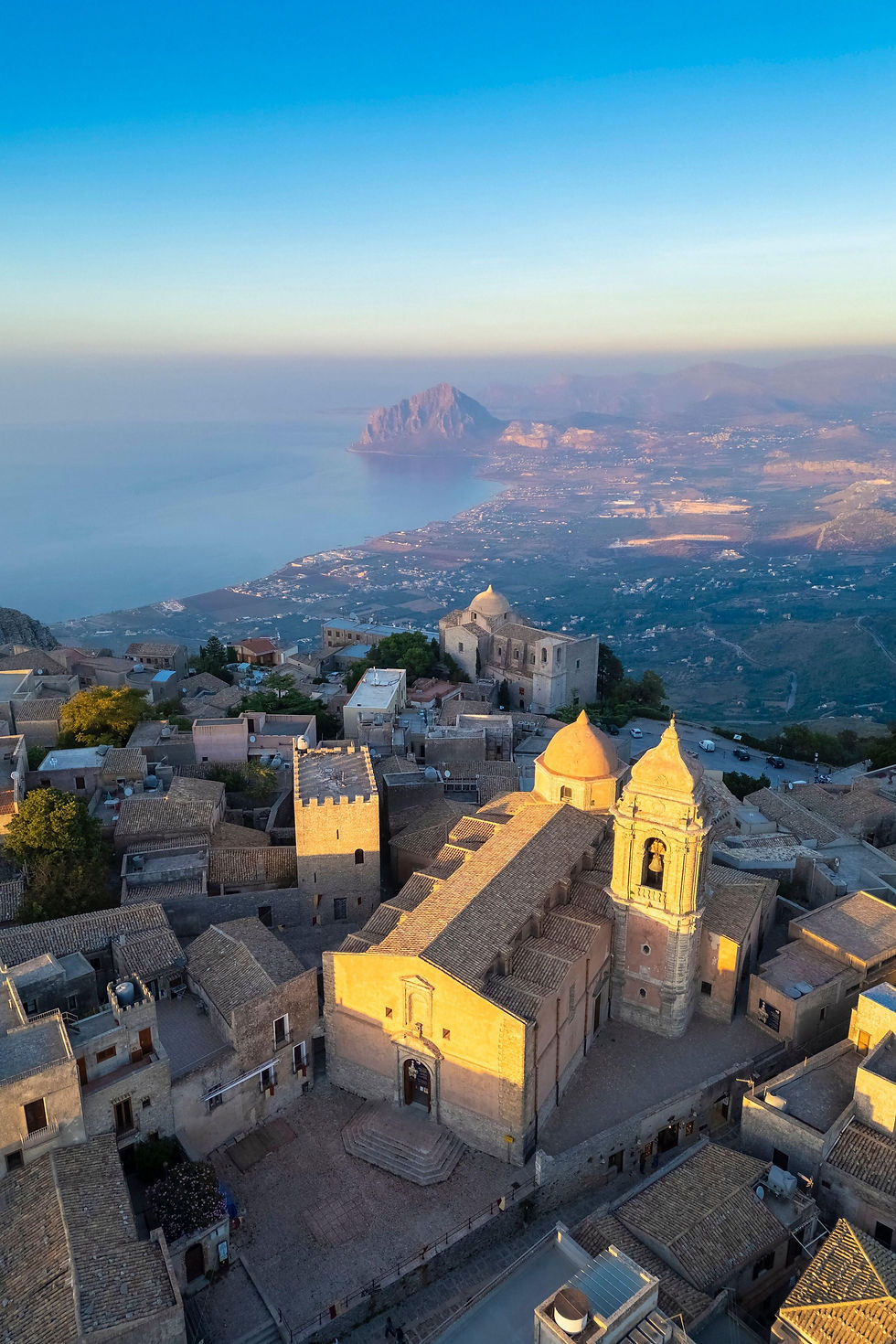
Photo: Mirko Costanini, Alamy
Explore further
San Giuliano's importance extends far beyond its architecture. The church is connected with one of Erice's oldest religious traditions, the medieval identity of the town and devotional practices that continue into the present day.
An ancient parish
Although the traditional foundation of San Giuliano is attributed to Roger I, surviving documentary evidence establishes the church's importance by the later Middle Ages.
In 1423, the testament of Archpriest Bernardo Militari described San Giuliano as a parish church. Militari was an important figure in medieval Erice and would later finance the construction of the gibbena, or portico, of the Chiesa Matrice in 1426.
San Giuliano remains one of Erice's four historic parish churches, together with the Chiesa Matrice, San Cataldo and Sant'Antonio Abate.
The feast of San Giuliano
The feast of San Giuliano is celebrated on 22 May and belongs to an old devotional tradition in the Trapani area. Celebrations include a solemn Mass and a procession through the streets of Erice, during which the statue of the saint is carried by the faithful.
The procession disappeared for decades during the long period in which the church was closed. The last procession before this interruption took place in 1965; following the restoration and reopening of San Giuliano, the tradition was revived in 2013.
The Misteri and ceroplastics
San Giuliano now houses the Misteri, sculptural groups representing episodes from the final hours of Christ's life. Traditionally associated with the Good Friday procession from the Church of Sant'Orsola, the groups were transferred to San Giuliano while Sant'Orsola underwent restoration, and the church subsequently became the usual starting point for the procession through Erice.
Rooms adjoining the church are also dedicated to ceroplastics, or wax modelling. In Erice this highly specialised craft was particularly associated with enclosed female religious communities. The Carmelite nuns of Santa Teresa, for example, created elaborate wax compositions known as campane, combining modelling with other decorative techniques.
Collapse and reopening
The partial collapse of San Giuliano in 1926 began an exceptionally long period of closure. For almost eighty years the church remained inaccessible for regular worship.
It finally reopened on 26 December 2005, restoring one of Erice's oldest parish churches to religious use.
During part of the closure, the piazzetta outside the church acquired another familiar religious landmark. From 1951 until 2015, the 17th-century marble statue of Sant'Alberto stood here after being removed from the Church of Sant'Alberto. It was eventually restored and returned to its original high altar.
Legends & mythology
The origins of San Giuliano are intertwined with medieval traditions surrounding the Norman conquest of Erice. These stories also attempted to explain the unusually strong relationship between Saint Julian and the town that was known for centuries as Monte San Giuliano.
Saint Julian and the Norman conquest
According to a local tradition recorded by the 19th-century historian Giuseppe Vito Castronovo, Saint Julian miraculously appeared on the walls of Erice during the Norman siege of the mountain in the 11th century. The saint was said to have assisted the forces of Count Roger I in capturing the fortified town.
A related tradition, recorded in the 17th century by Vito Carvini, attributed the foundation of three churches in the territory to Roger and his son Jordan following the Norman conquest: San Giuliano on the summit, Sant'Ippolito on the eastern slopes of Monte Erice and San Michele at Bonagia.
These accounts belong to later religious tradition rather than contemporary records of the Norman conquest, and the foundation of San Giuliano by Roger cannot presently be established as historical fact.
The saint who gave his name to the town
The association between San Giuliano and Erice became so strong that the town itself was known for centuries as Monte San Giuliano. According to local tradition, the name commemorated the saint's miraculous appearance during the Norman conquest, when he was said to have helped Count Roger I capture the fortified town.
This legendary explanation should be distinguished from the historical development of the place-name, but it reflects the importance San Giuliano acquired in Erice's civic and religious identity. The name Monte San Giuliano endured into the 20th century.
The identity of the saint himself is less straightforward. Ericine tradition has associated San Giuliano both with Julian of Anazarbus, an early Christian martyr, and with Julian the Hospitaller, the protagonist of a later medieval legend. Over time, these traditions became intertwined with stories of the Norman conquest and the foundation of the church, creating a complex body of religious tradition around San Giuliano and the medieval identity of Erice.
Sources & further reading
Explore the historical studies, ecclesiastical sources and local records used to document the Church of San Giuliano, its medieval origins, religious traditions and association with the historical identity of Erice.