Church of Sant'Agostino
A medieval Gothic church now serving as an exhibition venue
The Church of Sant'Agostino is a medieval church in Trapani's historic centre, best known for its Gothic façade and rose window, and today home to the Polo Espositivo Sant'Agostino.
Key facts
Site type:
Comune:
Exhibition Space, Church
Trapani
District:
Historic centre
The church is traditionally believed to have been founded during the Norman period in the 12th century as part of a church and hospice serving pilgrims travelling from Trapani to the Holy Land. Originally dedicated to Santa Maria del Tempio and later to San Giovanni Battista, it is closely associated with the Knights Templar before passing briefly to the Hospitallers following the suppression of the Templar Order in 1312. In 1314, Frederick III of Sicily transferred the complex to the Augustinian Order, which enlarged the church and gave it its present dedication. During the later Middle Ages and early modern period, Sant'Agostino became one of Trapani's principal ceremonial churches.
The church retains important features of its medieval Gothic architecture. Built of local stone with a single nave ending in a square apse, it stands in Piazzetta Saturno beside Porta Oscura. The façade is dominated by a Gothic rose window with intricate stone tracery, while the pointed entrance combines Norman and early Gothic elements. The rib-vaulted apse and surviving medieval fabric reflect successive phases of construction, despite damage during the Second World War and later restoration.
Since 2009, the former church has housed the Polo Espositivo Sant'Agostino, an exhibition space operated by the Museo Diocesano di Trapani. Temporary exhibitions showcase sacred art, local religious traditions and the artistic heritage of western Sicily, while associated conservation work has helped preserve artworks from churches across the diocese. Through its present role, Sant'Agostino continues to celebrate Trapani's religious and cultural heritage.
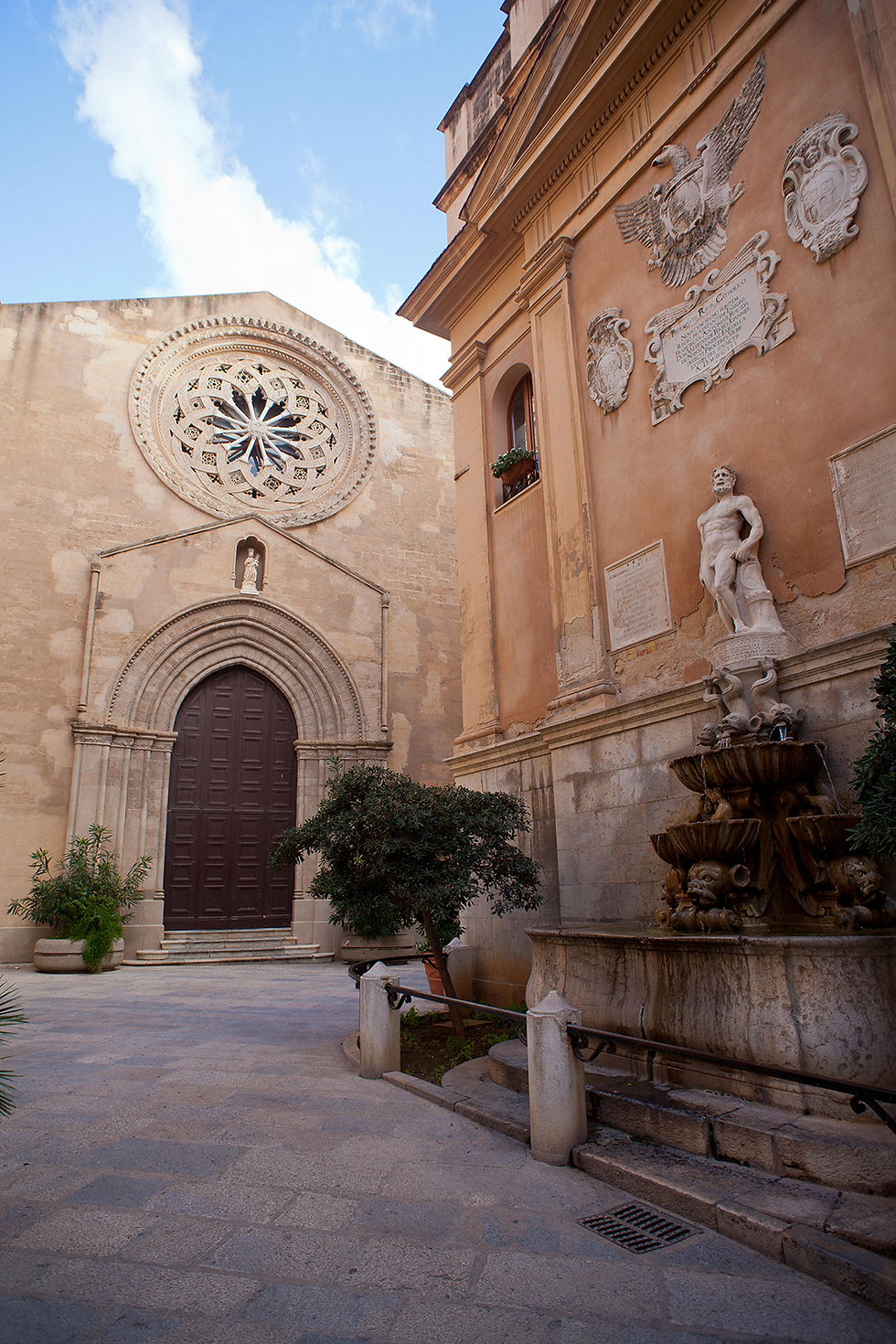
Photo: Giuseppe Anello, Alamy