Church of Sant'Agostino
A medieval Gothic church distinguished by its great rose window.
The Church of Sant’Agostino is a medieval Gothic church in Trapani, known for its monumental rose window and now used as a diocesan exhibition venue.
Key facts
Site type:
Comune:
Exhibition Space, Church
Trapani
District:
Historic centre
The Church of Sant’Agostino has medieval origins and was originally dedicated to Santa Maria del Tempio and later to San Giovanni Battista. Historical tradition associates the church and its adjoining hospice with the Knights Templar and with pilgrims travelling through Trapani towards the Holy Land. Following the suppression of the Templars in 1312, the complex passed to the Hospitallers of Saint John and in 1314 was granted by Frederick III of Aragon to the Augustinians, from whom it received its present dedication.
Under the Augustinians the church was enlarged and embellished. Its surviving medieval architecture includes a single-nave plan with square apse, an ogival entrance portal and the large Gothic rose window that dominates the façade. Formed from intersecting circular bands enriched with carved decoration, the rose window is the building’s most distinctive architectural feature.
Sant’Agostino also acquired an important civic role. In 1535 Emperor Charles V confirmed Trapani’s privileges here during his return from the conquest of Tunis, an event commemorated by an inscription inside the church. Later alterations, nineteenth-century restoration and damage during the Second World War changed parts of the building, while the adjoining convent disappeared. Since 2009 the former church has housed the Polo Espositivo Sant’Agostino, an exhibition space of the Diocese of Trapani devoted principally to sacred art and the religious heritage of the territory.
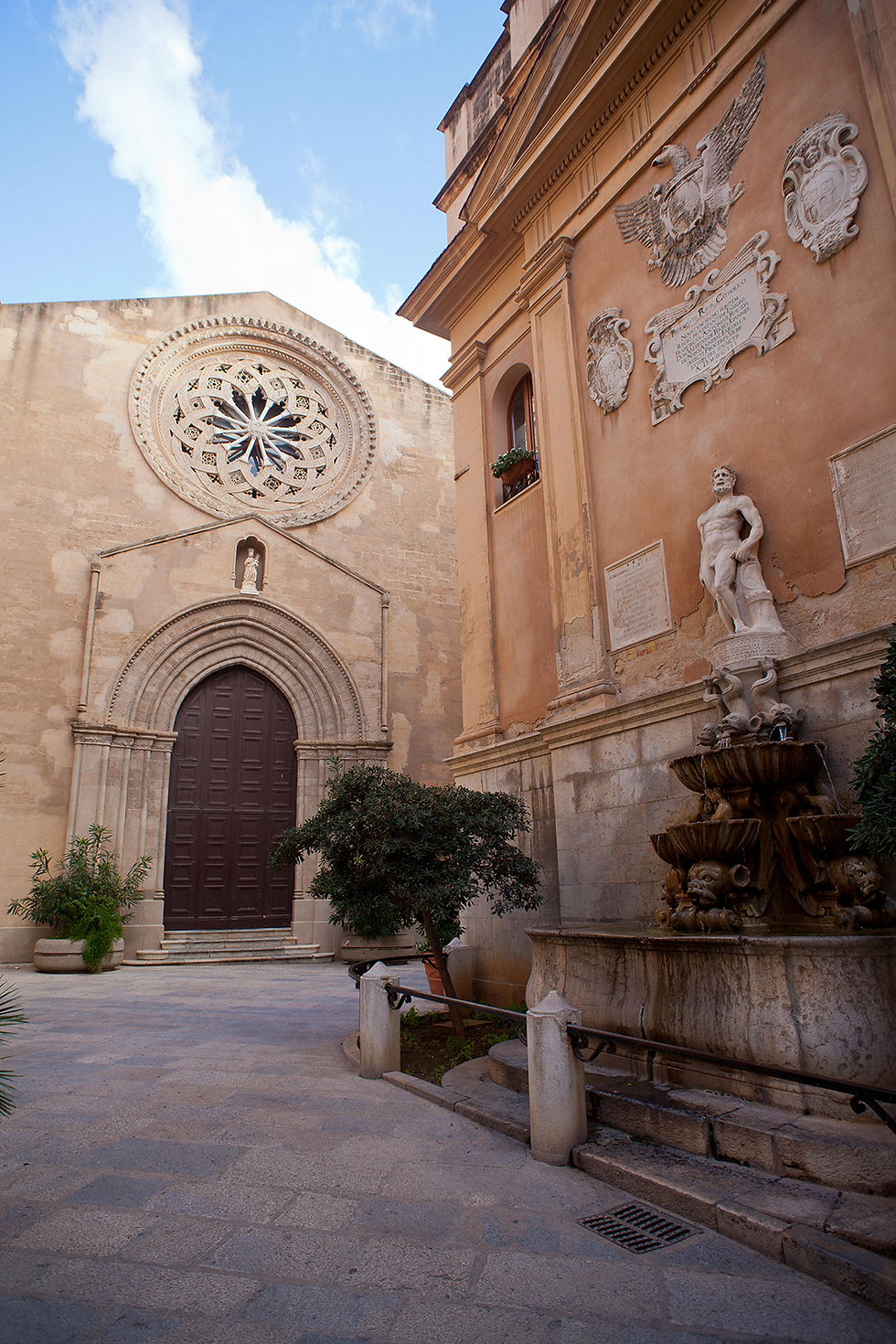
Photo: Giuseppe Anello, Alamy
Explore further
Explore the medieval origins of Sant’Agostino, its traditional association with the Knights Templar, the architecture and symbolism of its Gothic rose window, and its later role in the civic life of Trapani.
The Templars and the medieval church
The early history of Sant’Agostino is closely connected with Trapani’s role as a Mediterranean port and departure point for travellers towards the Holy Land. Historical tradition identifies the original church of Santa Maria del Tempio and its adjoining hospice with the Knights Templar, who are said to have acquired the site following the donation of a noble residence by Cardinal Enrico, or Arrigo, Beccadelli.
The complex provided religious and hospitaller functions associated with maritime pilgrimage. After the suppression of the Templar Order in 1312, its possessions in Trapani passed to the Hospitallers of Saint John. Two years later Frederick III of Aragon granted the complex to the Augustinians, beginning the phase that gave the church its present name and much of its later architectural identity.
The Gothic rose window
The large rose window is the defining feature of the façade of Sant’Agostino. Its stone tracery is organised around intersecting circular bands, with carved vegetal and ornamental motifs creating a complex geometric composition.
The window has attracted particular art-historical attention not only for its Gothic stonework but also for the symbolism identified in its design. Together with the ogival portal below, whose mouldings include diamond-pattern decoration, it preserves some of the clearest evidence of the church’s medieval architectural character.
A second ogival doorway survives, although now blocked, on the side of the building. Its sculpted keystone contains a figure that has been variously interpreted in historical and art-historical accounts.
Charles V and the civic church
During the later Middle Ages and early modern period, Sant’Agostino developed a role extending beyond the Augustinian community and became associated with public ceremonies of the city of Trapani.
One of the most important episodes took place in 1535, when Emperor Charles V visited Trapani after his campaign against Tunis. Within Sant’Agostino he confirmed the privileges of the city, an event subsequently commemorated by an inscription preserved inside the church.
The episode reflects the church’s historical position as both a religious building and a setting for important civic ceremonies involving the government of Trapani.
A changed interior
Historical descriptions show that the medieval and early modern interior of Sant’Agostino differed considerably from the space seen today. Giuseppe Polizzi recorded a richly decorated wooden ceiling composed of painted panels, which was removed during the nineteenth century.
Later restoration and the effects of the Second World War brought further changes to the building. Although much of its former decoration has disappeared, the façade, Gothic portal, rose window and architectural elements of the apse preserve important evidence of its medieval form.
Sources & further reading
Explore the historical studies, art-historical research and diocesan records used to document the medieval origins, Gothic architecture, civic role and modern use of the Church of Sant’Agostino.