Fontana del Tritone
A monumental fountain combining 19th-century civic history with modern sculpture.
The Fontana del Tritone is a monumental fountain in Trapani, combining an 1890 basin with a dramatic sculptural group by Domenico Li Muli.
Key facts
Site type:
Comune:
Fountain, Piazza
Trapani
District:
Historic centre
The Fontana del Tritone stands at the centre of Piazza Vittorio Emanuele, one of the principal public spaces created during the expansion of modern Trapani. Although now identified with its dramatic mythological sculpture, the fountain originated as a nineteenth-century civic monument connected with the city's water supply.
Its large octagonal basin was constructed in 1890 to commemorate the completion of the Dammusi aqueduct, which brought fresh water to the expanding city. The project formed part of the programme of public improvements associated with the Trapanese politician Nunzio Nasi. For several decades the basin remained without the sculptural group that defines its appearance today.
In 1951 the Municipality commissioned the Trapanese sculptor Domenico Li Muli to create a new centrepiece. Completed in the early 1950s, the composition depicts Triton on a shell-shaped chariot drawn by two hippocamps, surrounded by marine figures and creatures. Originally intended to be cast in bronze, it was instead executed in reinforced concrete because of financial constraints.
The resulting monument combines two distinct periods of Trapani's development: the late nineteenth-century investment in modern urban infrastructure and the expressive public sculpture of the post-war city.
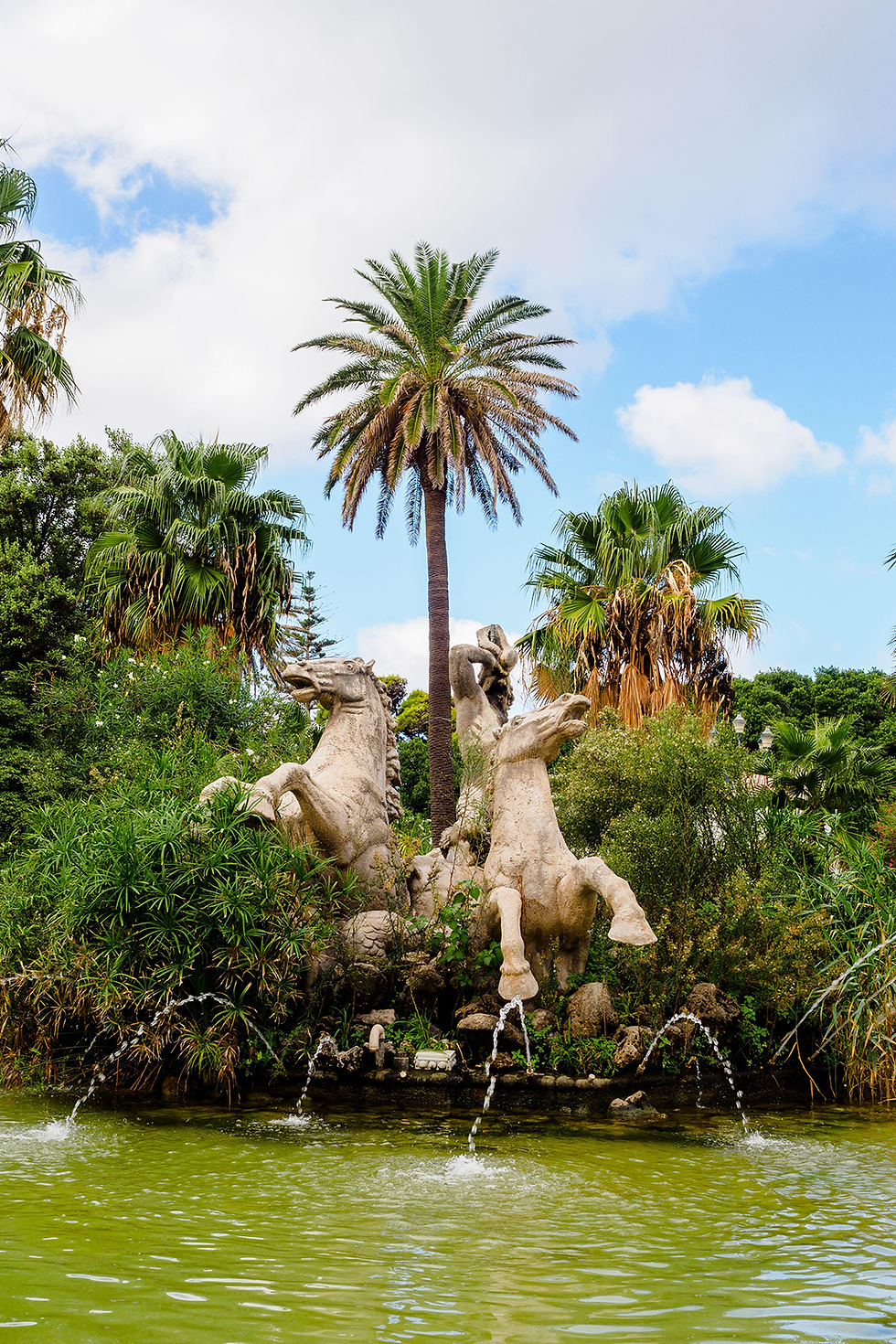
Photo: Stefano Ravera, Alamy
Explore further
Explore the two phases of the Fontana del Tritone, from the nineteenth-century aqueduct commemorated by its original basin to Domenico Li Muli’s post-war sculpture and its imagery drawn from the classical world.
The Dammusi aqueduct
The oldest part of the Fontana del Tritone is its large octagonal basin, constructed in 1890 as a civic monument celebrating the completion of the Dammusi aqueduct.
The new water supply formed part of the modernisation of Trapani during a period in which the city was expanding beyond its older fortified centre. Promoted during the political career of Nunzio Nasi, the aqueduct provided fresh water for the growing urban population.
The fountain therefore originally commemorated an achievement of civic engineering rather than serving primarily as a sculptural monument. For approximately sixty years the basin stood without the Triton group now associated with it.
Its position in Piazza Vittorio Emanuele placed this celebration of modern infrastructure within one of the principal public spaces of the expanding nineteenth-century city.
Domenico Li Muli
The present character of the fountain dates from the early 1950s, when the Municipality of Trapani commissioned the local sculptor Domenico Li Muli to create a monumental centrepiece for the existing basin.
Li Muli conceived the work as a large mythological composition originally intended to be executed in bronze. Financial constraints led instead to the use of reinforced concrete, a material that allowed the sculptor to retain the scale and complexity of his design at considerably lower cost.
Installed between 1951 and 1953, the group became one of Li Muli’s most prominent works in Trapani and transformed the nineteenth-century civic fountain into a major piece of twentieth-century public sculpture.
Triton and the sea
At the centre of Li Muli’s composition is Triton, the marine divinity of Greek mythology traditionally represented with the upper body of a man and the tail of a fish.
The figure stands on a shell-shaped chariot drawn through the water by two hippocamps, mythical creatures combining the forms of horses and fish. Other marine figures and creatures surround the central group, creating a theatrical composition designed to be viewed across the broad surface of the fountain.
The imagery gives the monument an explicitly maritime character particularly suited to Trapani. Rather than reproducing an ancient sculpture, Li Muli used figures inherited from classical mythology to create a modern monumental composition for the twentieth-century city.
Piazza Vittorio Emanuele
The Fontana del Tritone occupies the centre of Piazza Vittorio Emanuele, a major public space associated with the nineteenth-century expansion of Trapani beyond the historic city.
The fountain stands opposite the monument to Victor Emmanuel II, erected in 1882. Together, the two monuments reflect different phases in the development of the piazza: the celebration of the new Italian state, the civic improvements of the late nineteenth century and, with Li Muli’s sculpture, the addition of monumental public art in the post-war period.
The square therefore provides an important contrast with the dense medieval and Baroque streets of Trapani’s older historic centre, reflecting the emergence of a new civic landscape as the city expanded eastwards.
Sources & further reading
Explore the official and local sources used to document the Fontana del Tritone, from the construction of its nineteenth-century basin and the Dammusi aqueduct to Domenico Li Muli’s twentieth-century sculptural group.