Monte Cofano Nature Reserve
Limestone massif, Mediterranean habitats and ancient coastal landscape.
Monte Cofano Nature Reserve protects a limestone massif near Custonaci, with Mediterranean habitats, prehistoric caves and historic landmarks along its rugged coastline.
Key facts
Site type:
Comune:
Nature, Walking Route
Custonaci
District:
Cornino
Monte Cofano Nature Reserve protects 537.5 hectares centred on the limestone massif of Monte Cofano, which rises to 659 metres above the coast. Established in 1997, the reserve preserves a landscape shaped by carbonate rocks formed from ancient marine deposits and subsequently transformed by geological uplift and erosion. Karst processes have created caves, fissures, sinkholes and other distinctive formations across the mountain.
The reserve contains a varied mosaic of Mediterranean vegetation, including Ampelodesmos grasslands, dwarf-palm garrigue, Mediterranean scrub, oak woodland and specialised vegetation on the steep limestone cliffs. Its rugged terrain supports endemic plants and wildlife including Bonelli's eagle and the peregrine falcon, while the area is also important for migratory birds.
Human occupation around Monte Cofano extends back to the Upper Palaeolithic, with prehistoric evidence preserved in caves around Scurati and the mountain. Later activity has also left its mark through paths, former agricultural and pastoral land, rural buildings and coastal structures. Among the most prominent surviving landmarks are Torre San Giovanni and the Tonnara di Cofano. Today, walking routes through the reserve connect this natural and cultural landscape, passing beneath the mountain and along the surrounding coast.
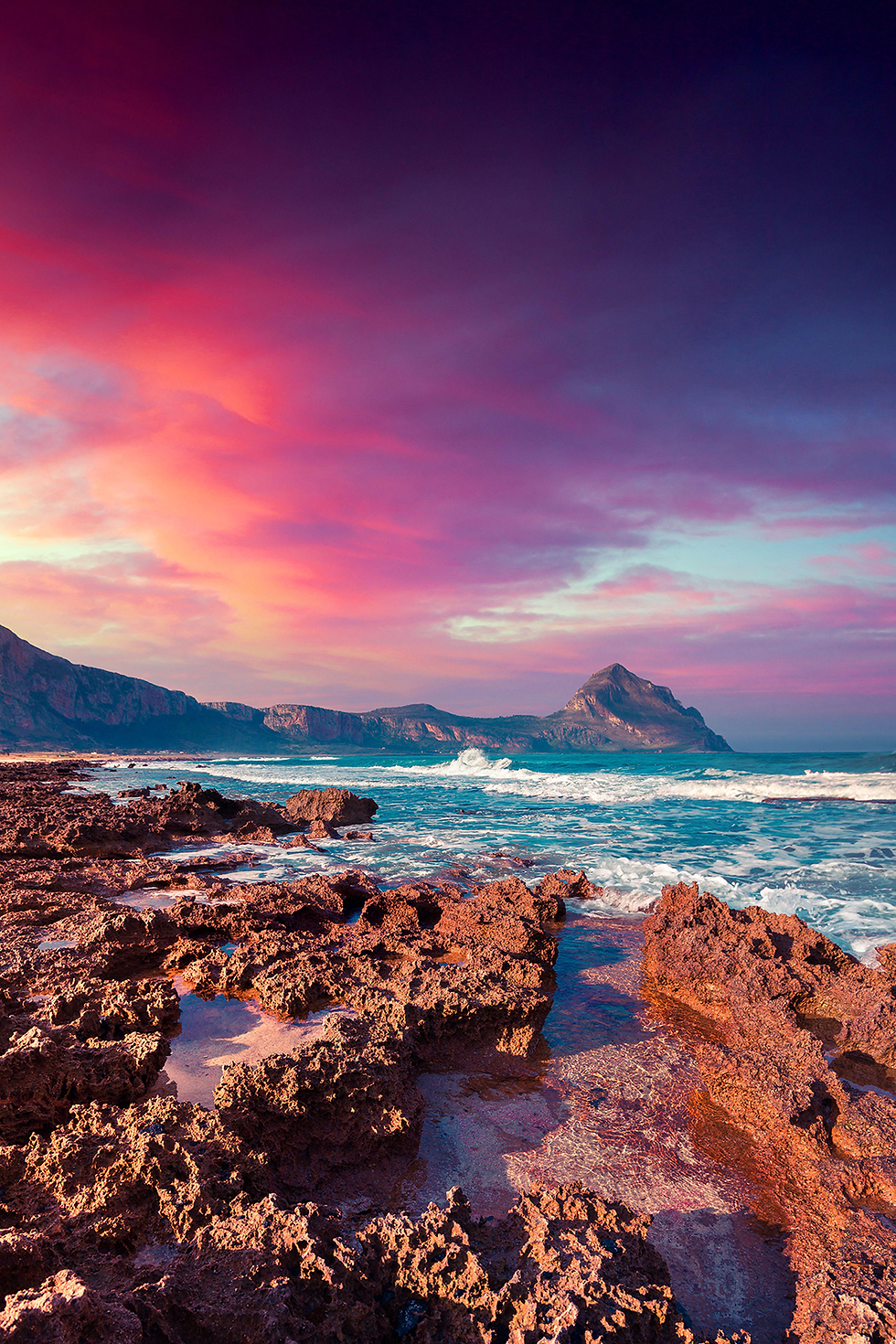
Photo: Andrew Mayovskyy, Alamy
Explore further
Explore the geological processes that created Monte Cofano, its distinctive Mediterranean vegetation and the evidence for thousands of years of human activity around the mountain.
A mountain shaped by ancient seas
Monte Cofano forms part of the carbonate mountain system of the Capo San Vito area. Much of the massif consists of Upper Triassic carbonate rocks, while other geological formations of different periods occur around its slopes and coastal margins. The mountain's steep morphology includes rock faces rising for several hundred metres, with the summit reaching 659 metres.
The carbonate geology has encouraged extensive karst development. Water gradually dissolving the rock has produced surface features such as grooves, pinnacles, corrosion basins and sinkholes, as well as substantial underground cavities. Recognised geosites within the reserve include the Grotta del Crocifisso and Monte Cofano area, the Gole di Cipollazzo and the Abisso delle Gole. Other major cavities include the Abisso del Purgatorio and Grotta di Monte Cofano.
The rocks also preserve evidence of their marine origins, including fossil remains, making the mountain an important record of the geological processes that shaped this part of western Sicily.
Prehistoric communities around Cofano
Human presence around Monte Cofano can be traced to the Upper Palaeolithic. Archaeological evidence from caves around Scurati and the Grotta del Crocifisso indicates occupation during the final phases of the Pleistocene, approximately 14,000–12,000 years ago.
The caves attracted antiquarian and archaeological interest from the nineteenth century onwards. Sebastiano Tusa records that Guido Dalla Rosa explored caves around the Cofano promontory and Scurati, while later investigations identified Epigravettian stone tools and other evidence of prehistoric occupation.
Archaeological research has also identified obsidian at Monte Cofano, a volcanic material not naturally available in the area. Analysis of this material has contributed to research into the circulation and provenance of raw materials in prehistoric Sicily, placing the communities around Cofano within wider networks of movement and exchange.
A changing Mediterranean landscape
The vegetation of Monte Cofano is the product of both environmental conditions and a long history of human use. Botanical research identifies a complex mosaic of plant communities determined by altitude, exposure, geology and soil, ranging from coastal vegetation and dwarf-palm garrigue to Mediterranean scrub, grassland and remnants of woodland.
Today, extensive areas are dominated by Ampelodesmos grassland, interspersed with dwarf palm, while holm oak and other woodland communities survive in more favourable locations. Particularly specialised vegetation occurs on cliffs, rocky slopes, scree and temporary pools, and the mountain supports plants of restricted or endemic distribution.
This landscape should not be understood as untouched wilderness. Historical agricultural, woodland and pastoral exploitation substantially altered the vegetation of the reserve, while abandonment of cultivation and repeated fires have continued to influence its development. The vegetation visible today therefore records both natural ecological processes and centuries of human intervention.
Human traces in the reserve
The protected landscape preserves evidence of human activity from prehistory into comparatively recent times. Alongside the caves around Scurati are former agricultural and pastoral areas, rural structures and routes that reflect successive ways of using the mountain and its surrounding land.
The relationship with the sea is represented particularly clearly along the coast. The Tonnara di Cofano preserves evidence of the area's historic tuna-fishing economy, while Torre San Giovanni formed part of the system of coastal observation and defence. The Regione Siciliana also records traces of fish-processing activity and an ancient settlement within the protected area.
Together, these remains make Monte Cofano not simply a geological and ecological reserve but a cultural landscape in which natural processes and human activity have interacted over thousands of years.
Sources & further reading
Explore the official records, botanical research and archaeological studies used to document the geology, vegetation, prehistoric occupation and changing human landscape of Monte Cofano.