Palazzo Senatorio
Trapani’s monumental Baroque palace of civic government.
Palazzo Senatorio, also known as Palazzo Cavarretta, is a Baroque civic palace in central Trapani, historically associated with the city’s Senate and municipal government.
Key facts
Site type:
Comune:
Palazzo
Trapani
District:
Historic centre
Palazzo Senatorio, also known as Palazzo Cavarretta, is one of the principal civic buildings of historic Trapani. Standing at the junction of Via Torrearsa and Corso Vittorio Emanuele, it developed on the site of the former Loggia dei Pisani and became the seat of the city’s Senate and magistracy.
The palace acquired its monumental Baroque appearance during the seventeenth century. Its present façade was constructed between 1671 and 1672 with the support of Giacomo Cavarretta. The lower two orders were designed by Pietro Castro, while the upper section was completed by Andrea Palma. Three niches contain statues of the Madonna of Trapani, Saint John the Baptist and Saint Albert, sculpted by Giuseppe Nolfo in 1701, combining the civic identity of the building with the religious patronage of the city.
Further work around 1696 enlarged the interior and rebuilt the monumental staircase. Palazzo Senatorio remained the centre of Trapani’s civic administration into the nineteenth century, when Giuseppe Maria Di Ferro described it as the Casa del Comune or Palazzo della Città. In 1828 a new public clock and calendar were installed above the façade, replacing the civic timekeeping function of the older astronomical clock on the adjoining Porta Oscura.
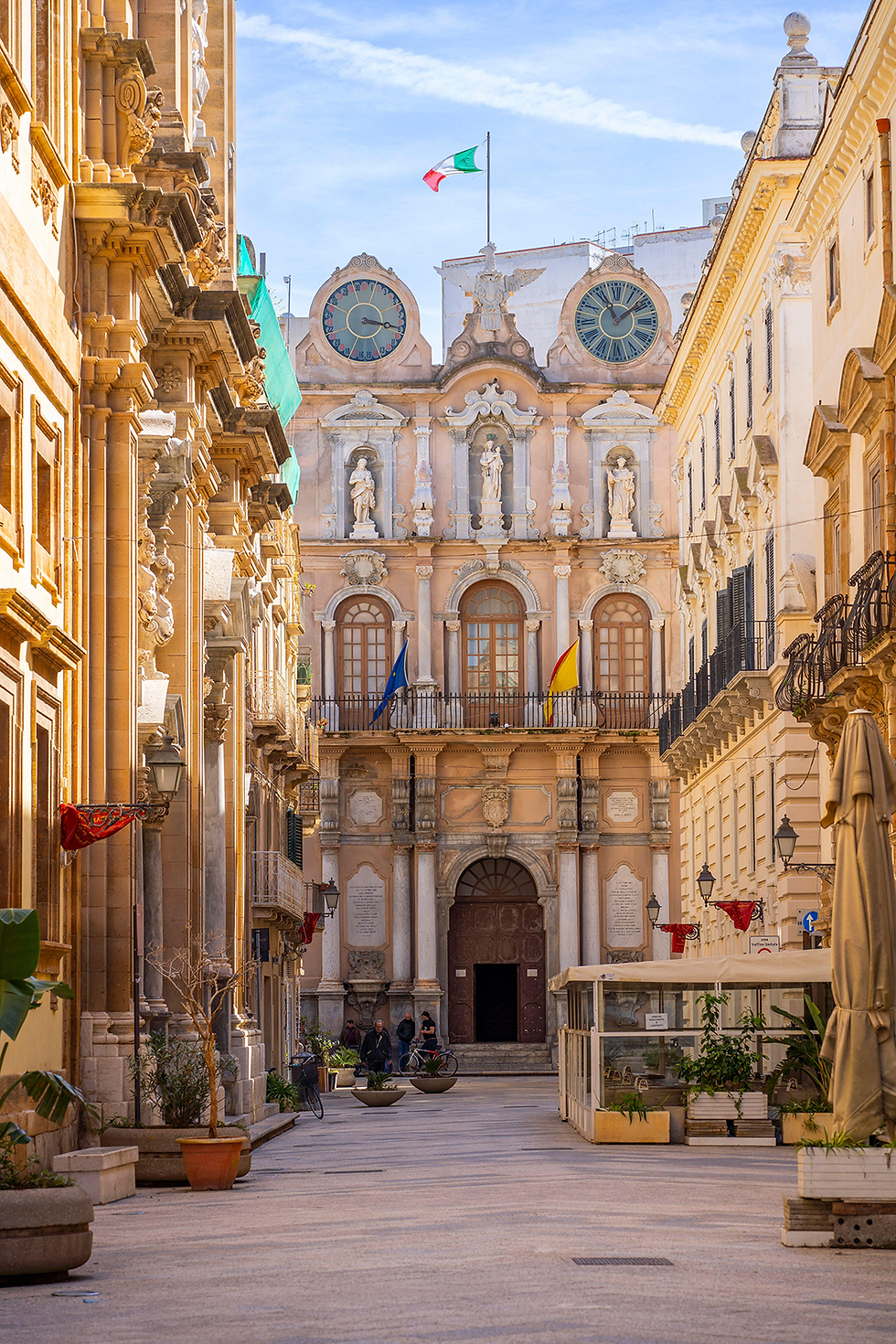
Photo: Gacro, Alamy
Explore further
Explore the development of Palazzo Senatorio as the historic centre of Trapani’s civic government, from its Baroque rebuilding and sculpted façade to the clocks that regulated public life in the city.
The civic palace
Palazzo Senatorio occupied an important position in the political life of early modern Trapani. Giuseppe Maria Di Ferro described the building in 1825 as the Casa del Comune or Palazzo della Città, the seat of the city’s Senate and the place where representatives assembled to deliberate on public affairs.
Its prominent position on one of Trapani’s principal streets gave architectural expression to this civic role. The palace stood beside Porta Oscura, the surviving medieval gateway that had once marked an entrance through the city walls but was subsequently absorbed into the developing civic complex.
The association of municipal government, public ceremony and civic timekeeping made this area one of the institutional centres of historic Trapani.
Giacomo Cavarretta and the rebuilding
The name Palazzo Cavarretta recalls Giacomo Cavarretta, whose patronage was closely associated with the transformation of the building. The monumental façade was constructed in 1671–72 with his financial support, replacing the earlier appearance of the civic palace with the imposing Baroque composition visible today.
Di Ferro also records a major renewal around 1696 under Fra Giacomo Cavarretta, Bailiff of Santo Stefano. The works enlarged the internal spaces, reconstructed the monumental staircase and contributed to the decorative development of the façade. A portrait of Cavarretta was preserved within the palace as a civic acknowledgement of his contribution.
These interventions transformed the existing municipal building into a monumental architectural statement appropriate to its role as the seat of Trapani’s government.
The Baroque façade
The façade of Palazzo Senatorio is arranged in three superimposed architectural orders. Pietro Castro designed the lower two levels, while Andrea Palma completed the upper section, creating the monumental composition that closes the vista along Corso Vittorio Emanuele.
The upper order contains three niches with statues carved by Giuseppe Nolfo in 1701. At the centre is the Madonna of Trapani, flanked by Saint John the Baptist and Saint Albert. Their presence above the seat of civic government linked the political identity of the palace with the religious devotions of the city.
The combination of architecture and sculpture makes the façade one of the most prominent expressions of Baroque civic architecture in Trapani.
The civic clocks
For centuries, public timekeeping at this location was associated with the tower above the adjoining Porta Oscura. Its astronomical clock indicated the phases of the Moon and served as Trapani’s principal public clock, with its sound intended to carry across the city.
In 1828 two new clock cases were added above the façade of Palazzo Senatorio, containing a clock and calendar. The clock was made by Giuseppe Lorito of Marsala and assumed the public timekeeping role previously performed by the older astronomical clock.
The two monuments therefore preserve successive phases in Trapani’s civic measurement of time: the earlier astronomical clock associated with Porta Oscura and the nineteenth-century clock and calendar prominently displayed above Palazzo Senatorio.
Sources & further reading
Explore the historical, architectural and official sources used to document Palazzo Senatorio, its Baroque transformation, its role in Trapani’s civic government and the development of its façade and public clocks.