Zingaro Nature Reserve
Sicily's first nature reserve, protecting seven kilometres of coast.
Zingaro Nature Reserve is a protected coastal landscape between Castellammare del Golfo and San Vito Lo Capo, established in 1981 as Sicily's first nature reserve.
Key facts
Site type:
Comune:
Nature, Beach, Walking Route
San Vito Lo Capo, Castellammare del Golfo
District:
Gulf of Castellammare
The Zingaro Nature Reserve protects around 1,600 hectares of coastline and mountains extending for approximately seven kilometres between Scopello and San Vito Lo Capo. Its creation followed a major campaign against a proposed coastal road: thousands joined the Marcia dello Zingaro on 18 May 1980, and the reserve was established by regional law on 6 May 1981, becoming the first nature reserve in Sicily.
Rising from rocky coves to mountains approaching 900 metres, the reserve contains a varied mosaic of Mediterranean habitats. Dwarf palm garrigue, scrub, grasslands, woodland, rocky cliffs and humid valleys support around 700 recorded plant species, including numerous endemic and rare species. The cliffs and mountains provide habitat for peregrine falcons, Bonelli's eagles, ravens and other birds, while the promontory is an important stopping place for migrating species.
Zingaro is also a cultural and archaeological landscape shaped by thousands of years of human activity. Grotta dell'Uzzo preserves evidence of prehistoric occupation, while rural buildings, former agricultural land and traditional activities record more recent ways of life. Today a network of paths crosses the reserve between its coastal entrances, allowing the landscape to be explored without the road whose construction helped inspire its protection.
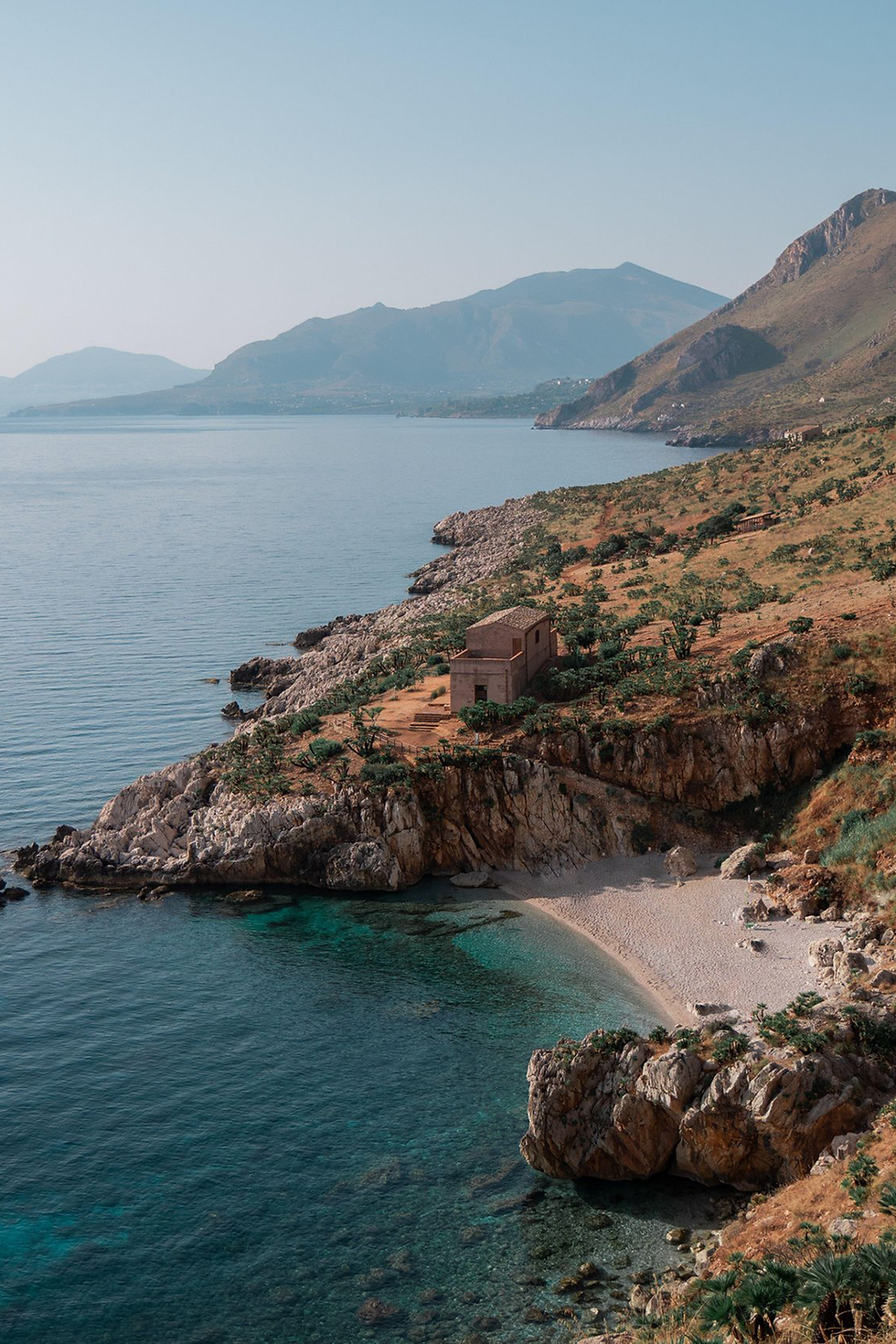
Photo: Riccardo Torre
Explore further
Explore the campaign that created Sicily's first nature reserve, the prehistoric archaeology of Grotta dell'Uzzo and the traditional communities that once lived and worked within the landscape.
The campaign to protect Zingaro
During the 1970s, construction began on a coastal road intended to connect Castellammare del Golfo with San Vito Lo Capo. The project would have carried a road through what was then one of the largest remaining undeveloped stretches of coastline in western Sicily.
Opposition brought together environmental organisations, naturalists and local campaigners. On 18 May 1980, thousands of people participated in the Marcia dello Zingaro, walking along the coast in protest against the road and calling for the landscape to be protected. The campaign became an important moment in the development of environmental conservation in Sicily. The following year, Regional Law no. 98 of 6 May 1981 established the Riserva Naturale dello Zingaro, the island's first nature reserve. The Regione Siciliana continues to commemorate the march as the event that helped initiate Sicily's system of protected natural areas.
The unfinished road project also left a physical trace in the landscape: a tunnel near the southern entrance at Scopello survives from the abandoned works.
Grotta dell'Uzzo and prehistoric settlement
Grotta dell'Uzzo, a large cave close to the northern coast of the reserve, is one of Zingaro's most important archaeological sites. Although investigated previously, it was brought to renewed archaeological attention by Giovanni Mannino in 1972, with systematic excavations beginning in 1975.
Excavation revealed a long sequence of occupation spanning the Mesolithic and Neolithic periods, together with later prehistoric material. Radiocarbon evidence from the excavated sequence extended approximately from the middle of the ninth millennium to the beginning of the fifth millennium BCE. Archaeologists also uncovered a Mesolithic burial area; by the publication of the early excavation results, eight graves containing ten individuals had been identified.
The remains of animals, molluscs and plants, together with tools and other archaeological material, have made the cave particularly important for understanding changing patterns of subsistence as communities moved from Mesolithic hunting, fishing and gathering towards Neolithic food production.
A lived landscape
Zingaro's landscape was shaped not only by prehistoric communities but by generations of farmers, shepherds and fishermen. Research around Grotta dell'Uzzo records the cultivation of wheat, vines, almonds and olives, together with the collection of manna and sumac. Dwarf palm, now one of the characteristic plants of the reserve, also had a practical role: its fibres were worked into ropes, baskets and fishing nets.
Small rural settlements and farm buildings were scattered through the mountains. Borgo Cosenza, in the higher interior, preserves evidence of one such community, while fishing formed another part of the local economy along the coast. The surviving rural buildings are therefore more than picturesque features: together with abandoned fields, paths and other traces of cultivation, they document a landscape in which human activity and the natural environment were closely connected.
Habitats and wildlife
The considerable variation in altitude and terrain within Zingaro supports habitats ranging from rocky coastline and dwarf-palm garrigue to Mediterranean scrub, woodland, cliff vegetation and the wetter environments of valleys and seasonal pools. The Regione Siciliana records around 700 plant species, including numerous endemic, rare and locally distributed plants.
Birdlife includes the peregrine falcon, Bonelli's eagle, common raven and rock partridge, while the reserve's position also makes it important for migrating birds. Caves provide habitat for bats, and seasonal freshwater environments support amphibians and the freshwater crab. Along the shore, sections of biogenic reef formed by marine organisms — known as trottoir a vermeti — add another specialised habitat to the reserve's ecological diversity.
Conservation within the reserve has also included active species management. Research published in 2014 documented a programme involving the release and radio-tracking of Hermann's tortoises (Testudo hermanni) in an area dominated by Ampelodesmos grassland, Mediterranean vegetation and limestone outcrops.
Sources & further reading
Explore the official records, geographical research and archaeological and zoological studies used to document the creation of the Zingaro Nature Reserve, its natural habitats and the long history of human occupation within its landscape.