Castle of Venus
Ancient sanctuary and medieval fortress on the summit of Erice
The Castle of Venus is a 12th-century Norman fortress built over the sanctuary of Venus Erycina, one of the most renowned sacred sites of the ancient Mediterranean.
Key facts
Site type:
Comune:
Castle, Archaeological Site
Erice
District:
Historic centre
The summit of Monte Erice had been a sacred site for centuries before the Norman castle was constructed. By the Classical period it was occupied by a sanctuary associated with the goddess of Eryx, later identified with the Phoenician Astarte, Greek Aphrodite and Roman Venus Erycina. Under Roman rule the cult acquired particular prominence, and temples dedicated to Venus Erycina were established in Rome itself.
The present castle was built in the 12th century, reusing stone and architectural elements from the ancient sanctuary. It occupies an isolated rocky spur protected by steep cliffs and formerly separated from the adjoining plateau by a deep ditch. The castle formed a fortified complex with the adjacent Balio Towers, originally connected by a drawbridge and later by the present stone ramp.
The west front retains Guelph battlements, a machicolation above the entrance, a mullioned window and the coat of arms of Charles V. Within the castle are remains of the medieval church of Santa Maria della Neve, architectural fragments from the ancient sanctuary and structures interpreted as part of a small Roman bath complex.
Under Spanish rule the castle housed the governor of Monte San Giuliano and later its permanent garrison. It subsequently served as a prison before falling into disuse. Archaeological investigations begun in the 20th century have revealed further evidence of the sanctuary and the long occupation of the site.
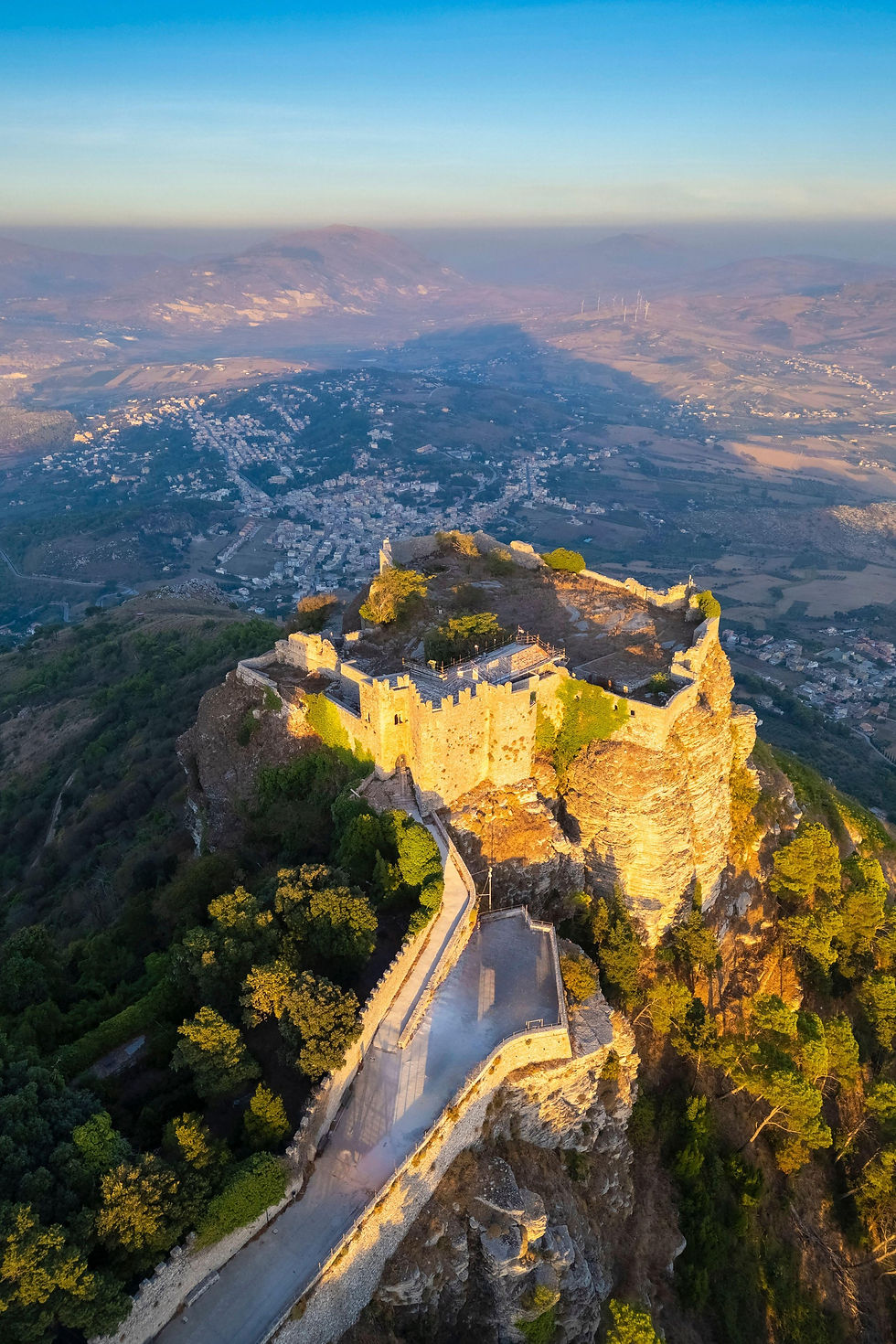
Photo: Mirko Costantini, Alamy
Explore further
Discover the history, architecture, archaeology, people and events connected with this place, with more detailed information about its origins, development and significance.
The sanctuary of Venus Erycina

The rocky summit occupied by the castle was a sacred site long before the construction of the medieval fortress. The precise origins of the sanctuary remain uncertain, but worship on Monte Erice developed within the cultural setting of the Elymians and their close contacts with the Phoenician world. The goddess worshipped there was subsequently identified by Greek writers with Aphrodite and by the Romans with Venus, acquiring the title Erycina from Eryx.
By the Classical period the sanctuary was already widely known. When Athenian envoys visited western Sicily in 415 BCE, according to Thucydides, the Segestans showed them valuable dedications kept at the sanctuary at Eryx as evidence of the wealth available to support the proposed Sicilian expedition. The sanctuary remained important under Carthaginian rule and acquired particular prominence after the Roman conquest of western Sicily.
The Romans adopted Venus Erycina as an important goddess in her own right. A temple dedicated to her was established on the Capitoline Hill in Rome during the Second Punic War in 215 BCE, followed by another outside the Porta Collina in the early 2nd century BCE. During the reign of Tiberius, a delegation from Segesta petitioned the emperor for the restoration of the sanctuary at Eryx, indicating that it retained importance into the Imperial period.
Ancient accounts also associate the sanctuary with priestesses, sacred doves and distinctive rituals connected with the goddess.
What did the sanctuary look like?
Little survives from which to reconstruct the appearance of the ancient sanctuary. Successive phases of building, followed by the construction of the Norman castle, have obscured its original layout, while surviving architectural fragments are insufficient to establish the form of the temple with certainty.
One possible indication survives on a Roman silver denarius issued by Gaius Considius Nonianus in 57 BCE. Its reverse depicts a four-columned temple standing on a rocky summit, surrounded by a fortified enclosure with a gateway and towers. The image is generally identified with the sanctuary of Venus Erycina on Mount Eryx. It provides a Roman representation of the site, although it cannot be assumed to be a precise architectural record of the temple.
Ancient writers provide a few further details. The sanctuary was renowned for its wealth, and Aelian described its altar as the largest known. Architectural fragments recovered from the castle area, including column drums and carved stonework, confirm the presence of substantial ancient buildings but do not allow the sanctuary itself to be securely reconstructed.
The sanctuary and ancient Eryx
The sanctuary was physically distinct from the ancient city of Eryx. Archaeological and topographical research places the principal settlement on the northern side of the summit plateau, within fortifications constructed from at least the early 5th century BCE. The sanctuary occupied a separate spur at the highest part of the mountain, divided from the adjoining plateau by a deep natural ravine.
Its position gave the sacred precinct considerable natural protection. Ancient sources distinguish between the city and sanctuary, and during the final stages of the First Punic War the two could be held independently. Hamilcar Barca occupied Eryx while a Roman garrison controlled the sanctuary on the summit. Roman control followed the defeat of Carthage in 241 BCE.
The surviving Elymian-Punic Walls principally enclosed the urban settlement rather than the sanctuary and help define the extent of ancient Eryx.
From sanctuary to fortress
The later history of the sanctuary is less clearly documented. Archaeological material indicates continued activity during the Roman period, but the chronology of its eventual abandonment and the appearance of the site in the intervening centuries remain uncertain.
Following the Norman conquest of Sicily, a fortress was built on the sanctuary rock during the 12th century. Its builders made use of the same topography that had isolated and protected the ancient sacred precinct. Steep cliffs defended much of its perimeter, while the ravine separating the rock from the adjoining plateau became part of the castle's defensive system.
Ancient stonework was reused in the medieval buildings, leaving material from the sanctuary incorporated into and scattered around the later fortress. The construction of the castle therefore preserved some evidence of the earlier site while making its original arrangement difficult to reconstruct.
The Norman castle
The castle follows the irregular form of the rocky spur rather than a regular geometric plan. Its principal surviving elevation faces west towards the town and the Balio. Defensive features include Guelph battlements and a machicolation above the entrance, while a mullioned window and later alterations record subsequent phases of occupation.
Within the enclosure stood the church of Santa Maria della Neve, associated with the Christian occupation of the former sanctuary. Its surviving remains form part of the complex archaeological sequence within the castle.
The Andalusian traveller Ibn Jubayr visited Sicily in 1184–85 and described the fortified mountain he called Jabal Hamid. His account refers to strong defences, ditches and bridges that could be cut in time of danger, and to the use of the fortified area as a place of refuge.
Castle and Balio
The Castle of Venus and the Balio Towers are now usually encountered as separate monuments, but historically they formed parts of a connected fortified complex.
The castle occupied the more isolated eastern rock and served principally as a military stronghold. The Balio stood on the adjoining plateau and was associated with the bajulo, the royal official responsible for the administration of justice and taxation. In later centuries this distinction remained visible in the division between military and civic authority: the governor or Castellano was based in the castle, while administrative functions were associated with the Balio.
A drawbridge originally crossed the ditch between the two areas. It was replaced in the 16th century by the stone ramp that still provides access to the castle, partly filling the earlier gap.
The castle under Spanish rule
During Spanish rule the castle served as the residence of the governor of Monte San Giuliano, who held military responsibility for the town and its territory. Its elevated position also gave it a role in the defence of the surrounding coast during periods of maritime raids.
In the early 17th century a separate barracks for a permanent Spanish garrison was planned elsewhere in the town. Construction began on what is now known as the Spanish Quarter, but the project was abandoned. From 1632 the garrison was instead accommodated in the Castle of Venus.
The fortress later served as a prison before gradually losing its military and administrative functions and falling into disuse.

Archaeology of the sanctuary
The medieval castle preserves evidence of several earlier phases of occupation. Architectural material associated with the sanctuary includes column drums and other carved stonework, although successive rebuilding makes it difficult to determine the original appearance or plan of the temple.
Excavations in 1930–31 identified rooms beside the north-western perimeter wall containing suspensurae — supports used to raise a floor above a heated space — together with traces of mosaic flooring. These remains have been interpreted as part of a small Roman bath complex.
Other features have acquired traditional interpretations that are no longer generally accepted. A large circular cavity known as the Well of Venus, for example, was associated with the ancient cult but is now interpreted as a grain silo.
Ancient masonry surviving within the castle precinct has similarly been associated with the Wall of Daedalus, described by Diodorus Siculus. The traditional name reflects the ancient story rather than establishing the wall as the structure described in the myth.
Archaeological investigations have continued in more recent periods, but the Norman castle and centuries of subsequent occupation limit what can be reconstructed of the sanctuary beneath it. Ancient, Roman, medieval and later remains therefore survive together rather than as clearly separated monuments.
The castle today
The Castle of Venus is owned by the Comune of Erice and is open as a historic and archaeological monument. A major programme of structural consolidation and restoration was completed in 2025, addressing areas affected by deterioration and improving access within the complex.
The works also prepared spaces for exhibitions and possible museum use, while archaeological remains from the ancient sanctuary and later phases continue to form part of the monument itself.
Legends & mythology
Explore the myths, legends, folklore and ancient traditions associated with this place, including the stories, figures and beliefs that have shaped its cultural identity.
Eryx, Aeneas and the sanctuary
Ancient writers preserved different traditions about the foundation of the sanctuary.
Diodorus Siculus attributed it to Eryx, the mythical ruler from whom the mountain and city were said to take their name. In his account, Eryx was the son of Aphrodite and Butes, one of the Argonauts, and established a sanctuary in honour of his mother. Other traditions gave Eryx a different parentage, including one in which he was a son of Poseidon.
Virgil incorporated the sanctuary into the Trojan story. In the Aeneid, Aeneas returns to western Sicily after the death of his father Anchises. Before continuing his journey towards Italy, he establishes a sanctuary to Venus on Mount Eryx and appoints a priest to his father's nearby tomb.
These are different mythological traditions rather than alternative historical accounts of the sanctuary's construction.
Daedalus and the sacred enclosure
Diodorus Siculus also associated the sanctuary with Daedalus. After escaping from Crete, the legendary craftsman was said to have reached Sicily and entered the service of King Cocalus. Among the works attributed to him was a wall constructed at Eryx.
According to Diodorus, the approach to the sanctuary was so steep that Daedalus built a wall along the narrow route, allowing the sacred precinct to be defended by only a small number of men.
Ancient masonry surviving within the Castle of Venus has long been known as the Wall of Daedalus because of this account. Its association with the mythical craftsman is traditional; archaeological study of the surviving masonry provides a separate basis for understanding its date and construction.
The goddess and the sacred doves
Doves were closely associated with the goddess of Eryx. Ancient writers describe two festivals, the Anagogia and Katagogia, centred on the departure and return of the goddess.
Athenaeus and Aelian relate that during the Anagogia the doves normally found around the sanctuary disappeared. This was understood as the departure of the goddess for Libya or Africa. Nine days later, a conspicuous dove was said to return across the sea, followed by the other birds. Their appearance marked the Katagogia and the goddess's return to Eryx.
Beatrice Lietz has examined whether an actual ritual practice may lie behind these accounts. The homing behaviour of rock doves could have allowed birds to disappear from the sanctuary and subsequently return, although the surviving descriptions may also contain literary elaboration. Within the ritual itself, the movements of the birds appear to have represented the absence and presence of the goddess.
A dovecote survives within the medieval castle, but its presence should not by itself be taken as evidence of continuity with the ancient cult.
Sources & further reading
Explore the historical sources, archaeological research, books, academic studies and official records used to document this place, with links for further reading and research.