Elymian-Punic Walls
Ancient fortifications of the city of Eryx
The Elymian-Punic Walls are the surviving ancient fortifications of Erice, built and strengthened between the Elymian and Punic periods to defend the western side of the city.
Key facts
Site type:
Comune:
Fortification, Archaeological Site
Erice
District:
Historic centre
The surviving walls of Erice formed part of the defensive circuit of ancient Eryx, one of the principal centres of the Elymians of western Sicily. The earliest fortifications date to the beginning of the 5th century BCE, when a substantial wall of large stone blocks enclosed the northern part of the summit settlement.
The defences were extensively rebuilt between the late 4th and early 3rd centuries BCE, when Eryx was closely integrated into the Carthaginian sphere. This phase is characterised by more regular rectangular masonry, with Punic masons’ marks still visible on some blocks. The walls were later repaired and incorporated into the medieval fortifications as the town expanded beyond the ancient settlement.
Around 800 metres of the western circuit survive, incorporating Porta Spada, Porta Carmine and Porta Trapani and a sequence of defensive towers. The northern towers retain substantial ancient masonry, while those further south are principally medieval. Archaeological investigations have also identified the remains of Porta Castellammare and traces of the former eastern circuit.
The walls show that ancient Eryx occupied a smaller area than medieval Erice, concentrated mainly on the northern part of the summit. The sanctuary of Venus Erycina stood separately on the rocky spur now occupied by the Castle of Venus.
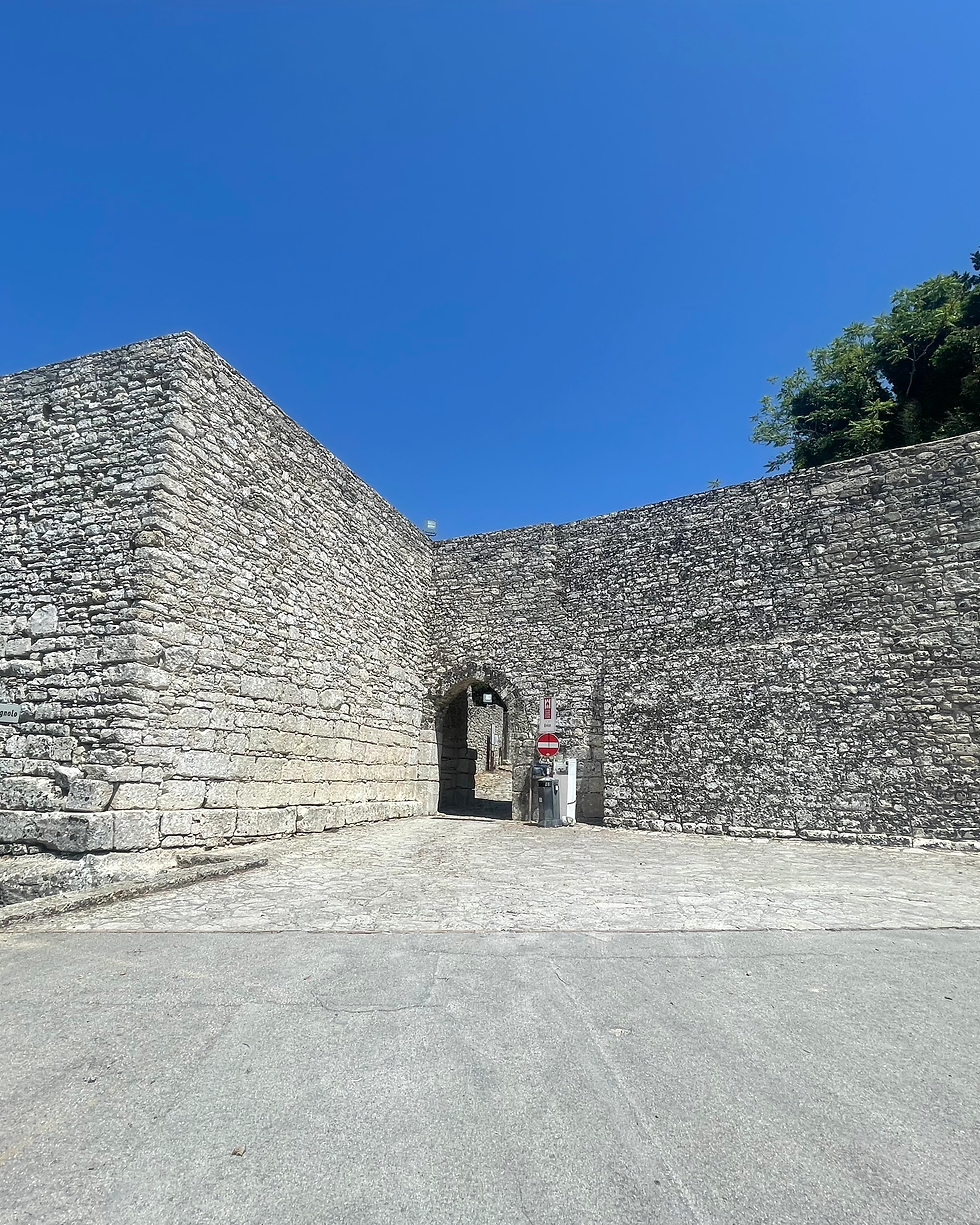
Photo: Elymian Atlas
Explore further
Discover the history, architecture, archaeology, people and events connected with this place, with more detailed information about its origins, development and significance.
The ancient city of Eryx
The walls surrounded the ancient city of Eryx, one of the principal centres of the Elymians of western Sicily. Although the mountain had been occupied earlier, archaeological evidence suggests that a more clearly defined urban settlement emerged around the late 6th and early 5th centuries BCE. Eryx was never a Greek colony, but its inhabitants participated in wider Mediterranean networks and adopted aspects of Greek material culture, language and coinage while maintaining close connections with the Phoenician and later Carthaginian world.
The ancient city did not occupy the whole area of modern Erice. Archaeological and topographical research places it principally on the northern part of the summit plateau, facing towards the coast and the port of Bonagia. The sanctuary on the site of the present Castle of Venus occupied a separate rocky spur to the south-east and lay outside the main inhabited area.
This distinction between city and sanctuary is important for understanding ancient accounts of Eryx. During periods of warfare, the settlement and the sanctuary could be occupied and defended independently.

Building the walls
Archaeological excavations have identified two principal ancient phases in the construction of the fortifications.
The earliest surviving wall was built at the beginning of the 5th century BCE. Its lower courses consist of very large, roughly worked blocks laid over foundations of smaller irregular stones. Excavations beneath Tower 8 uncovered an earlier paved surface and pottery dating to the late 6th and early 5th centuries BCE, providing evidence for the date of the first fortifications.
Their construction coincided with a period of major change in western Sicily. Following political upheavals around the time of the Battle of Himera in 480 BCE, settlements across the region were abandoned, reorganised or fortified. At Eryx, the new walls appear to have accompanied the development of a more structured urban centre.
The Punic fortifications
A second major phase of construction dates from the late 4th to the early 3rd century BCE, when Eryx was firmly within the Carthaginian sphere of influence.
Sections belonging to this phase were constructed from regular rectangular blocks laid in opus quadratum. Pottery associated with work around Tower 10 has helped date the rebuilding to around the beginning of the 3rd century BCE. Punic masons' marks carved into some of the stone blocks provide further evidence for the cultural setting in which the work was undertaken.
By this period Eryx was an important fortified stronghold. Coinage bearing the Punic form of the city's name and evidence for magistrates of Carthaginian type indicate the extent to which the settlement had become integrated into the Punic political and cultural world.
The necropolis of Piano delle Forche
Immediately outside the ancient city, near Porta Trapani, lies the archaeological area of Piano delle Forche, where a Punic necropolis was discovered in 1969 during building work. Excavations directed by archaeologist Anna Maria Bisi revealed burials dating principally from the late 4th and early 3rd centuries BCE.
The dead were cremated and their remains placed in containers, including both Punic and Greek amphorae. Archaeologists also identified deposits of ash and charcoal interpreted as areas used for cremation. Grave goods found with the burials included pottery, lamps, coins and small vessels such as unguentaria, although the objects deposited with the dead were generally modest.
The necropolis provides further evidence for the organisation and cultural connections of ancient Eryx. Its position beyond the fortifications reflects the separation of the burial ground from the inhabited settlement, while the presence of both Punic and Greek pottery reflects the wider Mediterranean influences already evident elsewhere at Eryx.
Gates and towers
The best-preserved fortifications extend along the western side of Erice, where the natural terrain offered less protection than the steep cliffs elsewhere around the summit.
At least eighteen towers can be identified along this circuit. The eleven northern towers are larger and contain ancient masonry, while the smaller towers extending southwards are principally medieval additions. This distinction has helped archaeologists reconstruct the probable limits of the ancient city.
Three principal gateways survive within the walls: Porta Spada, Porta Carmine and Porta Trapani. Archaeological investigation has also identified the remains of Porta Castellammare, on the northern side of the settlement. The gate faced towards Castellammare del Golfo and was associated with an ancient route ascending Monte Erice from the eastern side.
The gates, towers and wall sections visible today therefore belong to different periods. Ancient Elymian and Punic masonry survives alongside extensive medieval rebuilding and later repairs.
Pyrrhus attacks Eryx
The strength of the fortifications is vividly illustrated by an ancient account of the attack on Eryx by Pyrrhus of Epirus in 278 BCE.
Plutarch describes Eryx as strongly defended and held by a Carthaginian garrison. After driving the defenders back with missiles, Pyrrhus ordered ladders to be placed against the walls. According to the account, the king himself was the first to climb onto the fortifications, where he fought the defenders at close quarters while his soldiers followed him.
The city was eventually captured. Although Plutarch's narrative emphasises the personal bravery of Pyrrhus, it also provides a rare ancient description of an assault on the fortifications of Eryx while they were still functioning as the defences of the city.
Eryx and the First Punic War
The strategic importance of Eryx became particularly apparent during the First Punic War between Rome and Carthage.
In 260 BCE the Carthaginian commander Hamilcar transferred much of the population to Drepanum, modern Trapani, turning the mountain increasingly into a military position. During the final stages of the war, Hamilcar Barca established himself at Eryx while Roman forces controlled the sanctuary on the summit.
The ability of the two forces to occupy the city and sanctuary separately supports the archaeological interpretation of Eryx as a settlement distinct from the sacred precinct. Carthaginian resistance in the area continued until the Roman naval victory at the Aegates Islands in 241 BCE brought the war to an end.
Eryx subsequently passed under Roman control. The urban settlement gradually declined in importance, while the sanctuary of Venus Erycina continued to enjoy considerable prestige throughout the Roman world.
The medieval walls
The ancient fortifications continued to influence the development of Erice long after the decline of Eryx.
During the medieval period the settlement expanded southwards beyond the limits of the ancient city. Existing sections of the walls were repaired and incorporated into a larger defensive circuit, while new walls and towers were constructed. Major work took place particularly during the 14th century.
The difference can still be seen in the surviving masonry. The larger northern towers preserve ancient construction, whereas the smaller towers further south are associated principally with the medieval expansion.
The area once enclosed by ancient Eryx later formed part of the giudecca, the Jewish quarter of Monte San Giuliano. Following the expulsion of the Jews from Sicily in 1492, much of this northern district declined and remained comparatively sparsely inhabited.
Rediscovering ancient Eryx
The walls have played a central role in modern attempts to understand the location and extent of ancient Eryx.
Archaeological investigations began during the 19th century, including work by Antonino Salinas in the 1880s. Jole Bovio Marconi carried out excavations in 1957, followed by further investigations by Anna Maria Bisi in 1967. Near Tower 1, excavations uncovered part of a Punic votive stone dedicated to Tinnit and Baal Hammon, dating from the 4th or 3rd century BCE.
New excavations directed by Salvatore De Vincenzo between 2009 and 2014 substantially refined the chronology of the fortifications. Stratigraphic evidence and pottery associated with individual towers helped distinguish the early 5th-century construction from the later Punic rebuilding and subsequent medieval phases.
The research also helped establish the probable extent of ancient Eryx. Only the northern part of the modern town appears to have belonged to the ancient urban settlement, with Tower 11 marking approximately the southern limit of the surviving ancient western circuit.
The lost eastern circuit
Much less survives of the walls that once protected the eastern side of Eryx.
Recent research has examined surviving remains extending from the area of the Spanish Quarter towards the lost Porta Castellammare. The gate stood at the end of an ancient route ascending the eastern side of Monte Erice from the valley below.
Research published in 2025 by Gianmarco Girgenti, Fabrizio Avella and Davide Gianluca Abbate examined these remains using survey, graphical analysis and digital reconstruction. The surviving northern sections include dry-stone limestone masonry, while sections further south show construction more closely comparable with the medieval phases of the western fortifications.
Together with the western walls, these remains contribute to the continuing reconstruction of the ancient city's boundaries and the routes that once connected Eryx with the surrounding territory.
The walls today
The surviving fortifications remain one of the most extensive visible traces of ancient Eryx.
Conservation work has taken place since the 20th century, and in 2024 the Comune di Erice began a new restoration programme supported by approximately €1.94 million in PNRR funding. The project includes consolidation of the masonry, improvements to the paths around the walls and new interpretation for visitors.
The walls are therefore not the remains of a single period. Elymian construction, Punic rebuilding, medieval expansion and later restoration survive together, preserving more than two thousand years of the defensive history of Erice.
Legends & mythology
Explore the myths, legends, folklore and ancient traditions associated with this place, including the stories, figures and beliefs that have shaped its cultural identity.
Eryx and Heracles
Greek mythology associated the city and mountain with Eryx, a legendary Sicilian ruler from whom they were said to take their name.
Ancient traditions differ over his parentage. Diodorus Siculus describes Eryx as the son of Aphrodite and Butes, one of the Argonauts, while other accounts make him a son of Poseidon. He was remembered as a powerful ruler and formidable fighter.
The best-known story concerns the arrival in Sicily of Heracles, who was returning with the cattle of Geryon. One of the animals became mixed with the herds of Eryx, and the dispute that followed led the two men to a wrestling contest. Heracles defeated and killed Eryx and recovered the animal.
According to the tradition, Heracles did not immediately claim the conquered territory. Instead, he entrusted it to its inhabitants until one of his descendants should return to claim it. Centuries later this myth acquired a political dimension when the Spartan prince Dorieus attempted to establish a colony in the region and invoked his descent from Heracles as justification for his claim.
The story belongs to the mythology surrounding ancient Eryx rather than to the archaeological history of the surviving walls, but it illustrates how myths about the city and its territory could become connected with later political ambitions.
Saint Julian and the Norman conquest
A much later tradition associates the walls with Saint Julian.
Giuseppe Vito Castronovo recorded a local tradition according to which the saint appeared during the Norman siege of the mountain in the 11th century and assisted the forces of Count Roger I in capturing the city. The story later became associated with the name Monte San Giuliano, by which Erice was known for centuries.
The account belongs to local religious tradition rather than documented military history, but reflects the importance that Saint Julian acquired in the identity of the medieval town.
The Devil's Foot
Near Porta Spada, a footprint-shaped mark in the rock is associated with a local legend known as the Piede del Diavolo, or Devil's Foot.
According to the story, the Devil arrived in Eryx looking for new souls but found himself suffering from the bitter winter cold on the mountain. He learned that the wealthy inhabitants of the town had donated a new velvet cloak to the Madonna Addolorata in the nearby church of Sant'Orsola and decided to steal it for himself.
The smell of sulphur betrayed his presence to Saint Christopher, who pursued him through the town. The chase passed Porta Carmine and Sant'Orsola before the Devil fled towards Porta Spada. Unable to escape his pursuer, he finally fell from the walls.
Tradition holds that as he fell, the Devil struck the stone and left behind the imprint of his foot. The mark near Porta Spada is still known as the Devil's Foot.
The story survives as part of the folklore of Erice and links several places within the historic town — Sant'Orsola, Porta Carmine, Porta Spada and the ancient walls — within a single local legend.
Sources & further reading
Explore the historical sources, archaeological research, books, academic studies and official records used to document this place, with links for further reading and research.