Polo Museale “A. Cordici”
Museum tracing the history and artistic heritage of Erice
The Polo Museale “A. Cordici” is Erice's civic museum, bringing together archaeology, historic artworks and collections documenting the town from antiquity to the present.
Key facts
Site type:
Comune:
Museum, Conference Hall
Erice
District:
Historic centre
The Museo Civico “Antonio Cordici” was established by the municipality of Monte San Giuliano, now Erice, on 2 January 1876. Its purpose was to create a specifically Ericine museum by bringing together archaeological finds, inscriptions, coins and artworks, including material transferred to public ownership following the suppression of religious corporations after Italian unification.
The collection developed around archaeological material from the Hernandez collection, coins associated with the collections of Antonio Cordici and the Coppola family, and paintings, sculptures and other objects formerly belonging to the churches and monasteries of Erice. The museum was initially housed beside the Biblioteca Comunale “Vito Carvini” in the Palazzo Municipale and was reorganised in new rooms adjoining the library in 1975.
From 2011 the collections were progressively transferred to the former Franciscan complex on Vico San Rocco. The archaeological section opened in December that year, followed by historical-artistic, arms and contemporary-art displays; the completed Polo Museale opened in July 2015. Its collections now provide a broad material record of Erice, ranging from the ancient settlement and the cult of Venus Erycina to Renaissance sculpture, religious art and later artistic production.
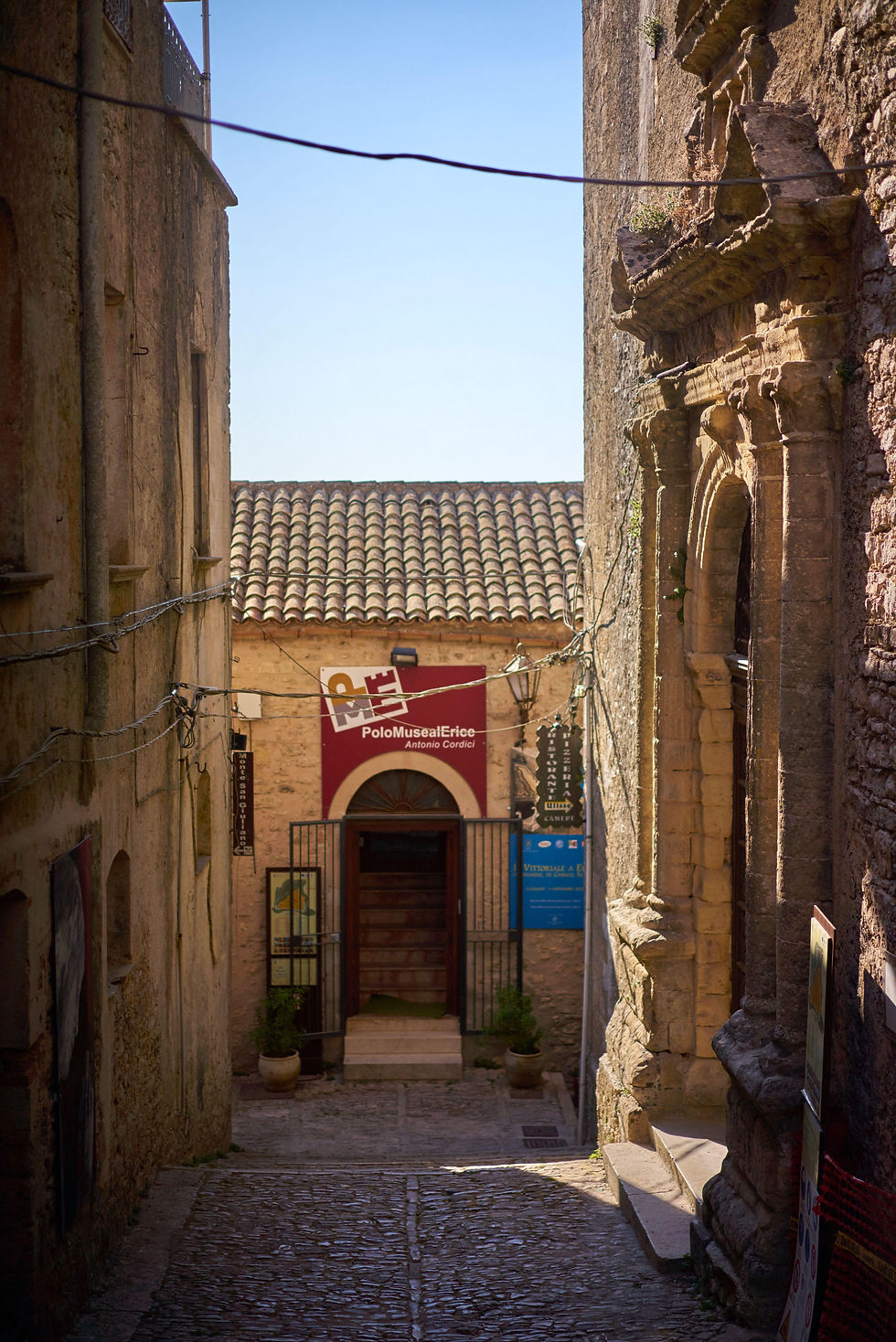
Photo: Andrius, Alamy
Explore further
Creating an Ericine museum
The origins of the museum are closely connected with the transformation of Erice's religious and civic institutions during the decades following Italian unification.
The municipal resolution of 2 January 1876 envisaged a museum containing artworks from the suppressed religious corporations together with inscriptions, coins, ceramics and marble antiquities, explicitly intending to form a Museo ericino. Material from the town's churches and monasteries was therefore brought together with existing private collections, particularly archaeological finds belonging to the Hernandez family and coins associated with Antonio Cordici and subsequently the Coppola family.

The museum was named after Antonio Cordici (1586–1666), an Erice historian and antiquarian whose work anticipated the later civic collection. Cordici assembled one of the town's earliest private collections of antiquities and historical material and wrote a seventeenth-century history of Erice, preserved in manuscript and later published in a modern critical edition. Material associated with his collection, including coins, subsequently entered the civic museum, which was dedicated to him in recognition of his pioneering role as a collector.
Initially the museum occupied a room adjoining the Biblioteca Comunale “Vito Carvini” on the ground floor of the Palazzo Municipale. In 1965 it received official classification as a Museo minore, and a conservation programme developed by the Sicilian authorities led to its reorganisation in improved premises beside the library in February 1975.
From museum to Polo Museale
A major transformation began in 2011 when the municipality started adapting the former Franciscan complex on Vico San Rocco as a larger museum capable of presenting the history of Erice through its movable cultural heritage.
The archaeological section opened in December 2011 under the supervision of archaeologist Sebastiano Tusa, displaying finds from the historic territory of Erice that had previously been difficult to access in the old museum. Further galleries were subsequently created for historical and artistic works and for the arms collection.
The completed Polo Museale opened in July 2015. The museum occupies the former convent adjoining the former Church of Saints Rocco and Sebastiano, today the Teatro Gebel Hamed.
Archaeology and the ancient city
The archaeological collection places the museum within a much longer history extending back to the ancient settlement of Eryx. Its objects include finds from the summit and the wider agro ericino, reflecting the successive cultures that occupied and used Monte Erice.

Among the best-known objects is a marble female head traditionally identified with Venus, recalling the celebrated sanctuary of Venus Erycina that once occupied the summit where the Castle of Venus now stands. The archaeological collection also includes a Neolithic terracotta pintadera, ceramics, inscriptions, coins and other finds documenting settlement and activity across the historic territory.
Rather than representing a single excavation, much of the early archaeological collection developed through antiquarian collecting and discoveries made throughout the former territory of Monte San Giuliano, particularly material belonging to the Hernandez collection.
Antonello Gagini's Annunciation
The outstanding Renaissance work in the collection is the marble Annunciation of 1525 by Antonello Gagini, originally created for the Carmelite Church of Maria Santissima Annunziata, commonly known as the Church of the Carmine.
The group was commissioned as an ex voto and originally stood in the second chapel on the right of the Carmine church. It comprises the kneeling Virgin and Angel, a lectern, small architectural elements and representations of God the Father and the Holy Spirit. The historian Giuseppe Castronovo recorded that the statues had originally been positioned against the wall before subsequently being moved onto the altar, a change he believed diminished their intended visual effect.
Following the suppression of the religious corporations, the sculpture passed into municipal ownership and was eventually displayed near the civic library. Its transfer to the present museum was a substantial undertaking: the five marble elements weigh approximately 450 kilograms in total.
The work is particularly significant because it preserves a direct connection between the museum and one of Erice's historic religious institutions: an artwork now encountered as a museum object can still be placed within the church for which it was originally created.
Art from the churches and monasteries of Erice
Much of the historical-artistic collection has a similar relationship with the religious buildings of Erice. Paintings, sculptures, liturgical furnishings and textiles entered municipal ownership following the suppression of religious communities in the nineteenth century, preserving works whose original institutional settings had disappeared or changed.
The collection includes seventeenth- and eighteenth-century paintings, religious furnishings and decorative arts. Among its textiles is an elaborate embroidered altar frontal from the Benedictine monastery of Santissimo Salvatore, made in the first half of the eighteenth century from silk satin embroidered with silver, gold and polychrome silk threads. It originally decorated the front of the high altar of the monastic church.
Other works include a marble well-head attributed to the Gagini school and originating from the Chiesa Matrice, religious sculpture, maiolica and works associated with Trapani's long traditions of alabaster, wax and coral craftsmanship.
Painting, arms and later collections
The museum also preserves paintings extending beyond the material inherited from suppressed religious houses. Its historical-artistic displays include seventeenth- and eighteenth-century works, including paintings by Domenico La Bruna (1699–1763) that underwent conservation through a collaboration with the University of Palermo. Other works were loaned from the Museo Pepoli in Trapani to complement the collection.
The wider holdings include a collection of historic arms, including material associated with the Garibaldian period, and a substantial group of works by the Ericine painter Alberto Augugliaro.
Sources & further reading
Explore the principal studies and institutional sources documenting the history of the Cordici Museum, its archaeological collections and the artworks brought together from the churches, monasteries and historic collections of Erice.