Fontana di Saturno
A medieval fountain supplied by the waters of Monte Erice.
The Fontana di Saturno is a historic fountain in central Trapani, established in 1342 as a public outlet of the Chiaramonte aqueduct.
Key facts
Site type:
Comune:
Fountain, Piazza
Trapani
District:
Historic centre
The Fontana di Saturno was established in 1342 beside the Church of Sant’Agostino as part of a new aqueduct bringing fresh water from the slopes of Monte Erice into Trapani. Sponsored by the powerful Chiaramonte family, the system provided an important source of drinking water for a city with limited freshwater supplies. An earlier basin at the site had received water known as Acqua Mageslana, but according to the nineteenth-century historian Giuseppe Maria Di Ferro this supply was abandoned because of its unpleasant taste.
The medieval fountain consisted of three marble basins with a larger bowl above, from which water flowed into the square. A statue of Saturn surmounted the structure, referring to the ancient god traditionally associated with the foundation of Trapani. The fountain and its water subsequently became known as Acqua Chiaramonta.
By the early seventeenth century both the fountain and Trapani’s water infrastructure required substantial work. In 1603 the Senate of Trapani financed the reconstruction of the fountain, including repairs to its basins, masonry and water conduits. This coincided with major improvements to the city’s water supply, including new conduits carrying water from the Misericordia springs. The reconstructed Fontana di Saturno survives in Piazza Saturno, preserving a visible link with Trapani’s medieval water system.
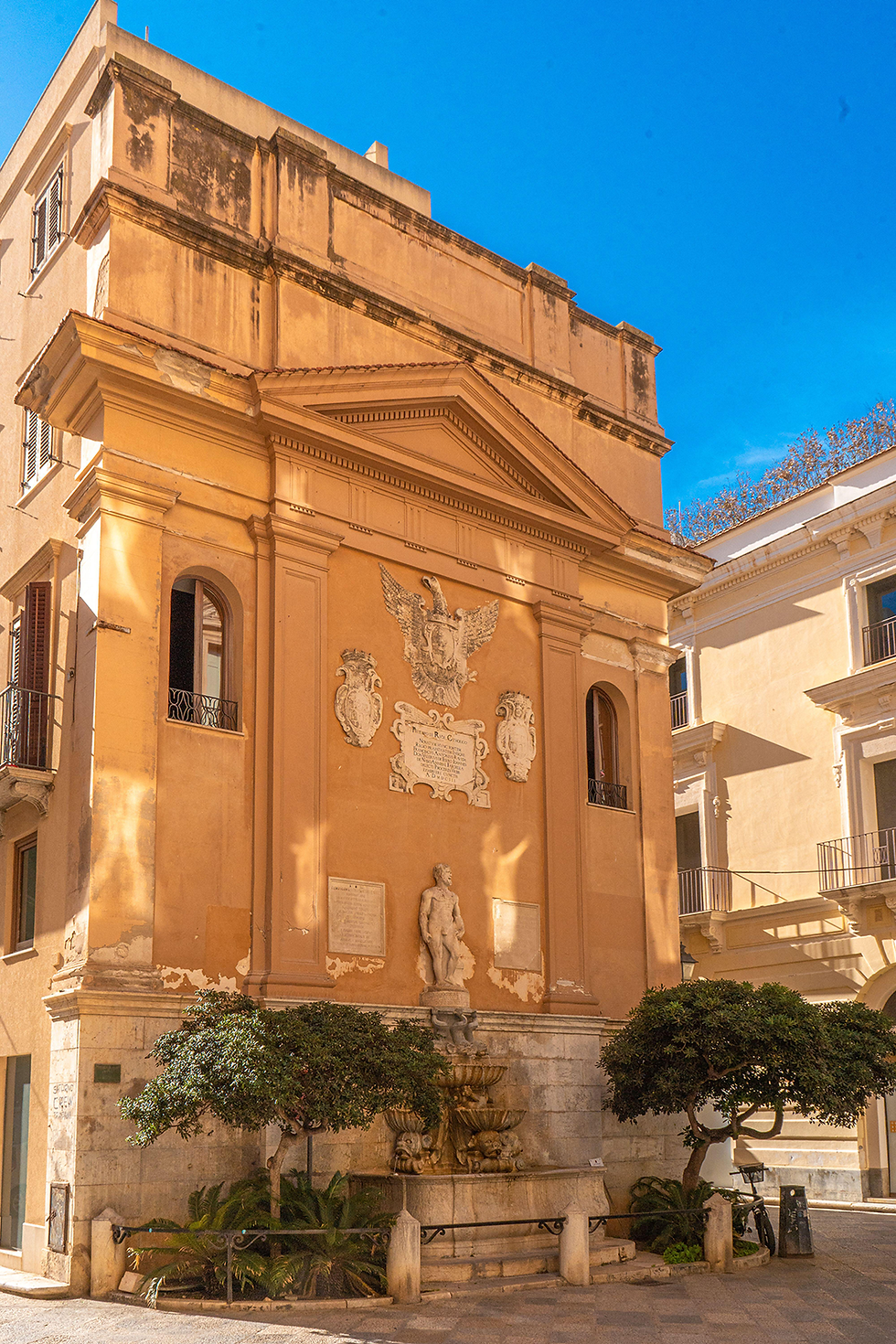
Photo: Libero Monteris, Alamy
Explore further
Water from Monte Erice
Trapani’s medieval water supply depended in part on the springs of Monte Erice. Water filtering through the mountain’s limestone emerged at numerous points on its slopes, providing water for settlements, agriculture and livestock. Historical sources record springs including Difali, Fontana Rossa, Giancuzzo, Puzzillo, Misericordia and Cappuccini.
The Chiaramonte aqueduct, constructed in 1342, carried water towards Trapani through a combination of covered stone channels known as embriciati, underground terracotta conduits or catusi, and elevated sections. The water eventually reached public outlets including the Fontana di Saturno.
The network underwent substantial changes over time. In the early seventeenth century water from the Misericordia springs was brought towards Trapani through new conduits and arches, entering the city near Porta Austriaca and supplying several public fountains.
The Chiaramonte family
The Chiaramonte were among the most powerful noble families of medieval Sicily. Their influence extended across the island during the fourteenth century, when members of the family held the County of Modica and accumulated extensive territories, political influence and connections with the Sicilian royal house.
Their presence was also established in western Sicily. In Erice, the former monastery of Santissimo Salvatore incorporates a building traditionally identified as a Chiaramonte palace. In Trapani, another family palace stood opposite the Church of San Nicolò, where the Chiaramonte maintained their own chapel.
Their sponsorship of the aqueduct in 1342 therefore formed part of a wider Chiaramonte presence in the area. By financing infrastructure that carried water from Monte Erice into Trapani, the family left a practical legacy that remained embedded in the city’s water supply long after their political power collapsed at the end of the fourteenth century.
Legends & mythology
Local tradition associated Saturn with the legendary foundation of Trapani, giving the ancient god a lasting place in the city’s identity and in the symbolism of the fountain.
Saturn and the origins of Trapani
According to a longstanding local tradition, Trapani was founded by Saturn, the ancient god whose statue crowns the medieval fountain. The association belongs to the city’s legendary history rather than its documented origins, but became sufficiently established in local tradition for Saturn to serve as a symbol of Trapani.
The statue gave the medieval fountain an identity extending beyond its practical role in the city’s water supply. Its name, Fontana di Saturno, preserves this association between the monument and the legendary origins of Trapani.
Sources & further reading
Explore the historical sources and research used to document the Fontana di Saturno, the Chiaramonte aqueduct, Trapani’s medieval water supply and the family responsible for its construction.