Palazzo Coppola
A historic residence associated with Giuseppe Coppola
Palazzo Coppola is a historic residence on Via Vittorio Emanuele in Erice, associated with Risorgimento leader Giuseppe Coppola, who died here in 1902.
Key facts
Site type:
Comune:
Palazzo
District:
Historic centre
Palazzo Coppola is a historic residence on Via Vittorio Emanuele in Erice, closely associated with Giuseppe Coppola, one of Monte San Giuliano’s leading figures during the revolutionary movements of 1848 and 1860.
The building has a long two-storey façade, with a comparatively restrained ground floor and a more richly ornamented upper storey. Stone-framed entrances are surmounted by projecting balconies carried on sculpted corbels, with turned stone balustrades. The upper windows have elaborate carved surrounds incorporating masks, floral and heraldic motifs, while a strongly projecting classical cornice completes the façade. The date of the building and the history of its architectural development have not yet been established.
Coppola took part in the Sicilian revolution of 1848 and, with Enrico Fardella, led the assault on Trapani’s Castello di Terra. Following the restoration of Bourbon rule, he was repeatedly arrested and spent periods of confinement on Favignana. In 1860 he returned to revolutionary activity, commanding local volunteers at the Battle of Calatafimi during Garibaldi’s campaign.
After Italian unification, Coppola withdrew from political and military life and returned to Erice. He died in this residence on 14 January 1902.
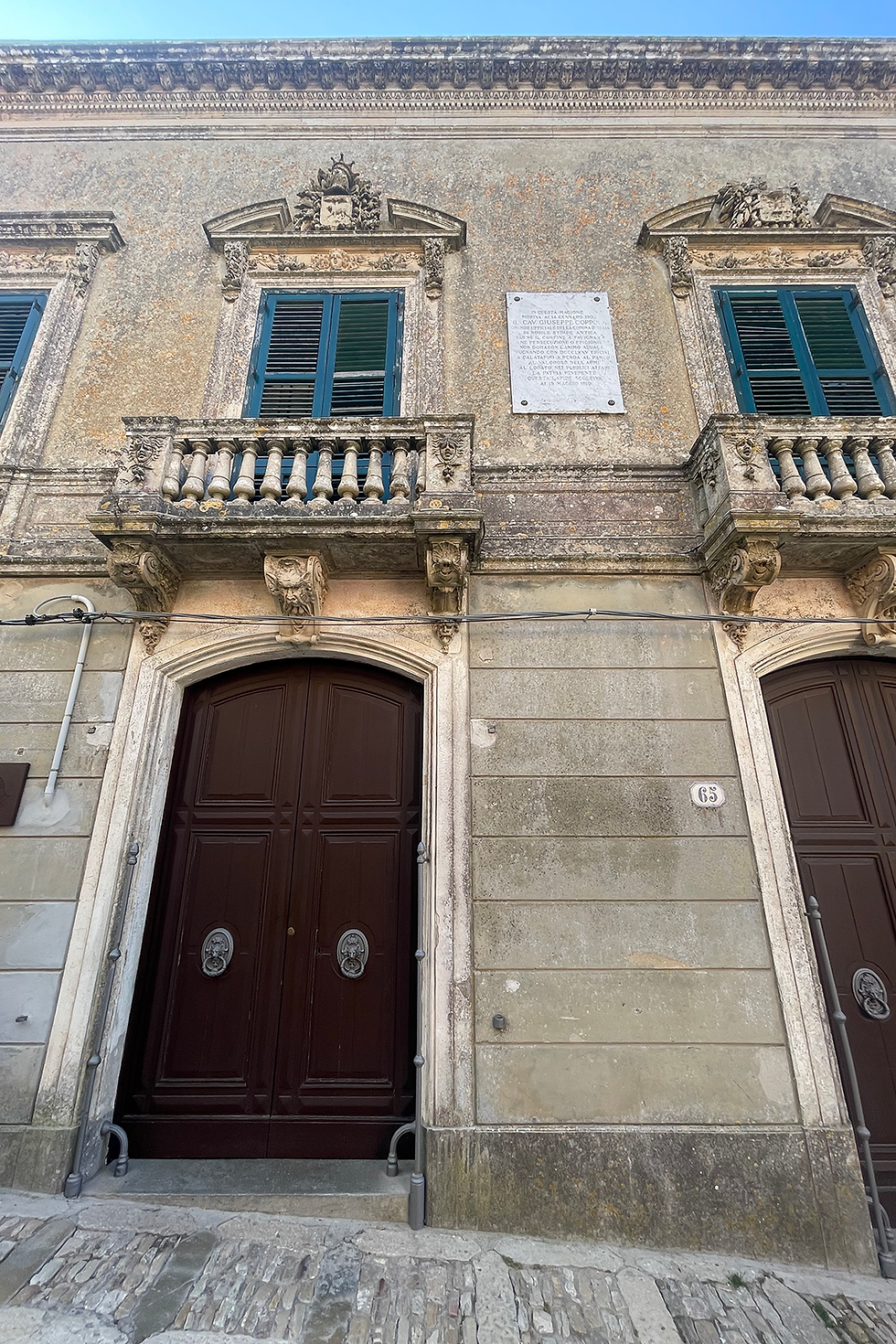
Photo: Elymian Atlas
Explore further
Giuseppe Coppola and the Risorgimento
Born in Monte San Giuliano on 18 March 1821, Giuseppe Coppola became involved in the revolutionary movement opposing Bourbon rule. During the Sicilian revolution of 1848 he was a prominent member of the revolutionary committee in Trapani and participated in the seizure of the Castello di Terra. He was subsequently appointed Vice-Governor of the province of Trapani and Major of the National Guard.
After the failure of the revolution, Coppola remained under suspicion because of his political activity. He was imprisoned several times, including periods on Favignana in 1856–57 and again at the end of 1859.
Released during the insurrection of April 1860, he reorganised local resistance. At the Battle of Calatafimi on 15 May, sources record him commanding a force of around 800 infantry and 25 cavalry. He subsequently accompanied Garibaldi’s advance towards Palermo and was entrusted with removing the remaining Bourbon garrison from Trapani and securing the surrounding territory.
The commemorative plaque
The marble plaque on the façade was inaugurated on 15 May 1910, fifty years after the Battle of Calatafimi. Its inscription, written by Ugo Antonio Amico, commemorates Coppola’s life, recalling his confinement on Favignana, political persecution and imprisonment, and his participation in the fighting at Calatafimi, Renda and Parco.
In questa magione - moriva il 14 gennaio 1902 - il Cav. Giuseppe Coppola - Grande Ufficiale della Corona d’Italia - di nobile stirpe antica - cui né il confino a Favignana - né persecuzione o prigione - non domaron l’animo audace - pugnando con DCCCXXVII Ericini - a Calatafimi a Renda al Parco - Al valoroso nelle armi - al lodato nei pubblici affari - la Patria reverente - questa lapide scopriva - ai 15 Maggio 1910.
English translation:
In this residence, on 14 January 1902, died Cav. Giuseppe Coppola, Grand Officer of the Crown of Italy, of an ancient noble lineage. Neither confinement on Favignana, nor persecution or imprisonment subdued his courageous spirit. He fought with 827 men of Erice at Calatafimi, Renda and Parco. To one valiant in arms and esteemed in public affairs, a grateful homeland unveiled this plaque on 15 May 1910.
Coppola was commemorated elsewhere in Erice during the same period. A bust in the Balio Gardens honours his role in the revolutionary movements, while a plaque on the Palazzo Municipale, also installed in 1910, commemorates the 875 men of Monte San Giuliano who joined the Garibaldian campaign under his leadership.
Sources & further reading
These sources document Giuseppe Coppola’s role in the revolutionary movements of 1848 and 1860, his association with the residence, and his commemoration in Erice.