Pepoli Turret
A romantic retreat overlooking the slopes of Erice
The Pepoli Turret is an eclectic late-19th-century pavilion built by Count Agostino Sieri Pepoli as a private retreat for study, contemplation and cultural gatherings.
Key facts
Site type:
Comune:
Palazzo, Museum
Erice
District:
Historic centre
The Pepoli Turret was built between 1872 and 1880 on a rocky spur below the Balio Gardens. Its construction formed part of Count Agostino Sieri Pepoli's transformation of the Balio, where from 1872 he restored the medieval towers and created a landscaped public garden on land obtained from the municipality.
Conceived as a "buen retiro", the Torretta was deliberately picturesque, combining medievalising and Moorish architectural elements in a composition of square and cylindrical towers. Favignana tuff, marble and coloured majolica were used throughout the building, which was carefully adapted to its rocky setting below the Castle of Venus and overlooks the wooded slopes of Erice.
Pepoli used the Torretta both as a secluded place for reading and study and as a setting for cultural gatherings. Among the writers, scholars and public figures associated with it were Ugo Antonio Amico, musicologist Alberto Favara, archaeologist Antonino Salinas and statesman Nunzio Nasi, forming part of the intellectual circle that gathered around Pepoli.
After a period of deterioration, the Torretta underwent extensive conservation and restoration before reopening to the public in 2022. It now houses an interactive multimedia museum exploring the history, myths and traditions of Erice and serves as a permanent Peace Observatory.
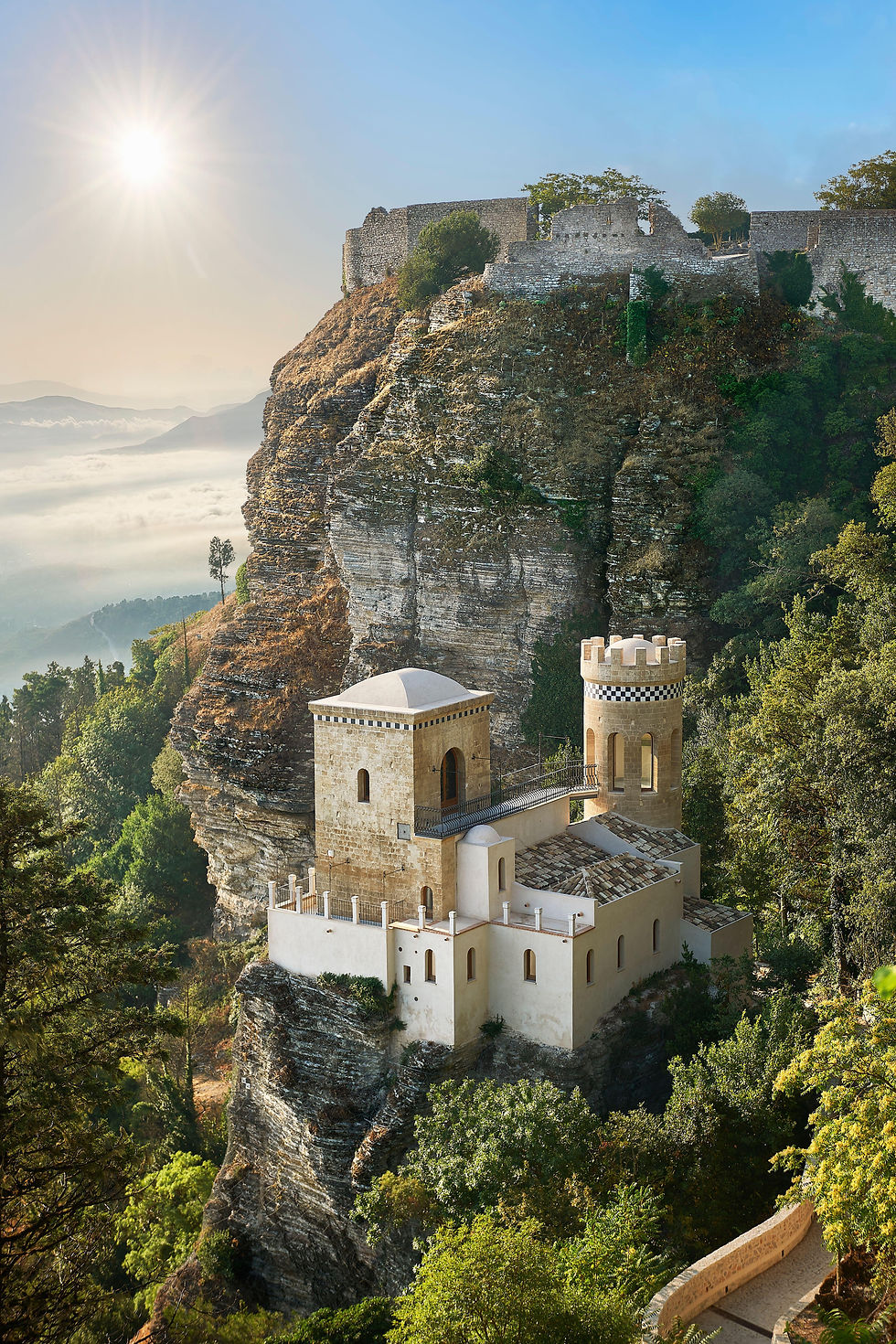
Photo: Paul Williams, Alamy
Explore further
Explore the transformation of the Balio in the late 19th century, the life and patronage of Agostino Sieri Pepoli, and the culture of villeggiatura that made Erice a summer retreat and gathering place for Trapanese society.
Pepoli and a changing Erice
The creation of the Torretta coincided with a period of significant change in Erice, then officially known as Monte San Giuliano. During the second half of the 19th century, the town's civic life was shifting away from the old Balio complex, while its landscape, medieval monuments and cooler mountain climate were acquiring a new importance for recreation and seasonal residence.
Municipal functions had moved from the Balio Towers to the centre of the town around 1861. The Palazzo Municipale near Piazza della Loggia was subsequently enlarged in 1874–75, reinforcing the square's role as the civic centre. The Balio, by contrast, was beginning to acquire a different purpose.
Pepoli was central to that change. In 1872 he reached an agreement with the municipality that allowed him to restore the medieval Balio Towers and develop the surrounding land as a public garden. Terraces, paths and planting transformed the former defensive and civic setting into a landscaped space from which the medieval towers and Castle of Venus could be appreciated as historic monuments within a carefully composed landscape.
The Torretta was constructed below the gardens as Pepoli's personal retreat. Rather than imitate a particular historical building, its architecture drew freely upon medieval and Moorish forms. Its towers, pointed openings, decorative stonework and coloured ceramics contributed to the romantic character of the Balio landscape, while its position on the rocks provided extensive views across the countryside below Erice.
About Agostino Sieri Pepoli
Count Agostino Sieri Pepoli (1848–1910) was a Trapani nobleman, collector and patron, born into the Sicilian branch of the Pepoli family. He travelled widely in Europe and spent periods in Bologna, while maintaining close connections with western Sicily and developing interests in art, history and collecting.
His patronage extended well beyond Erice. Drawing on his own collections, he founded Trapani's civic museum in the early 20th century, the institution that later became the Museo Regionale Agostino Pepoli. His work at Erice — restoring the Balio Towers, creating the gardens and building the Torretta — can therefore be understood as part of this broader interest in art, heritage and cultural life. At Erice, these interests also intersected with an established tradition that was changing the social character of the mountain town.
The culture of villeggiatura
By the late 19th century, Erice had become a favoured summer retreat for aristocratic and bourgeois families from Trapani, who moved from the heat of the coastal city to the cooler mountain during the summer months.
Later accounts recall an annual movement of families and household possessions up the mountain, particularly for the month of August, with residents returning to Trapani as the first autumn mists arrived. This formed part of a wider seasonal pattern among wealthy Trapanese families, whose year could also include periods at seaside residences and country estates in the Agro Ericino.
Pepoli did not create this tradition, but his work at the Balio belonged to the changing social and cultural environment that surrounded it. The restoration of medieval buildings, creation of landscaped public gardens and construction of the Torretta gave physical expression to a growing appreciation of Erice for its history and landscape as well as its climate.
The Torretta also developed a cultural role of its own. Pepoli received writers, musicians, archaeologists and political figures there, including Ugo Antonio Amico, Alberto Favara, Antonino Salinas and Nunzio Nasi. It therefore functioned not simply as an ornamental pavilion or private residence, but as a small meeting place for the intellectual circle surrounding its owner.
Restoration and present use
After Pepoli's death in 1910, the Torretta eventually passed into municipal ownership and suffered a prolonged period of deterioration. A major conservation programme begun in the early 21st century included structural consolidation, restoration of its architectural and decorative elements and work to the surrounding paths and landscape.
The restored building reopened to the public in 2022 as the Pepoli Interactive Multimedia Museum. Its displays explore the history, archaeology, myths and traditions of Erice, with Count Pepoli himself used as the narrative voice through which the town is presented.
The Torretta also serves as a permanent Peace Observatory, described as a “Lighthouse of the Mediterranean”. More than a century after Pepoli used the building for study and cultural exchange, it has therefore returned to a public cultural role within the landscape he helped create.
Sources & further reading
Explore the sources used to research the history, architecture and cultural context of the Pepoli Turret.